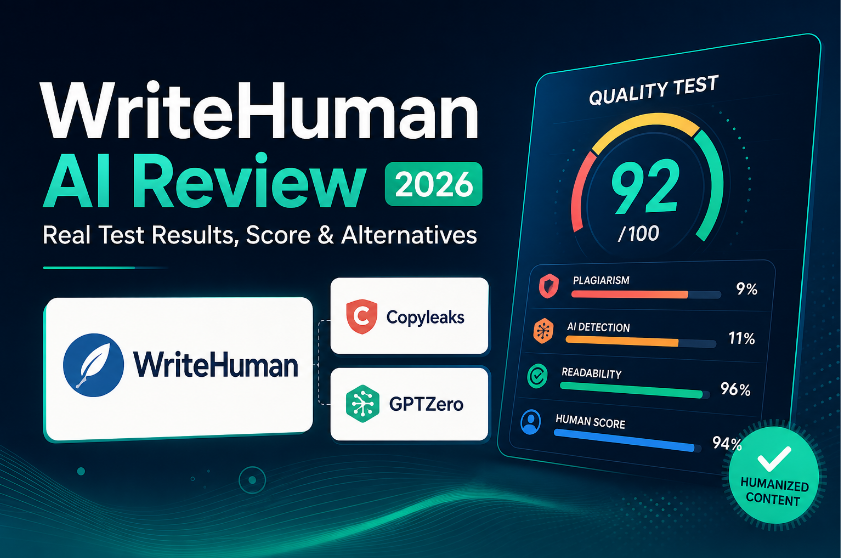
Most WriteHuman AI review articles you'll find online are written by competing tools. HumanizerPro reviews WriteHuman and recommends itself. BypassGPT reviews WriteHuman and recommends itself. You already know how that story ends.
I wanted to write a WriteHuman review that actually helps you decide whether this tool fits your workflow, without funneling you into a checkout page by paragraph three.
WriteHuman launched in 2023, founded by Ivan Jackson in Arlington, Virginia. The tool takes AI-generated text from ChatGPT, Claude, Gemini, or Jasper and rewrites it to score lower on AI detection tools like GPTZero, Originality.ai, Turnitin, and Copyleaks. It markets itself as "the world's most powerful AI humanizer." That's a bold claim.
And after cross-referencing multiple independent tests, reading 218 Trustpilot reviews, and analyzing the actual output quality for SEO use cases, I can tell you exactly where that claim holds up and where it falls apart.
What WriteHuman AI Actually Does (And What It Doesn't)
WriteHuman is a browser-based AI humanizer that rewrites AI-generated content to reduce detection scores. You paste text, pick a humanization mode, and get back a rewritten version. Simple enough.
The tool offers two processing modes. Standard mode does surface-level word swaps. Enhanced mode, available only on paid plans, makes deeper structural changes and produces noticeably better output. If you're paying, always use Enhanced.
One feature that sets WriteHuman apart from most competitors and almost identical to our HumanizeAIText is keyword freezing. You can bracket specific words or phrases — like brand names, technical terms, or SEO target keywords — and WriteHuman will preserve them in the rewritten output. For SEO professionals, that's genuinely useful. Most humanizers strip out or rewrite your target phrases, forcing you to re-insert them manually.
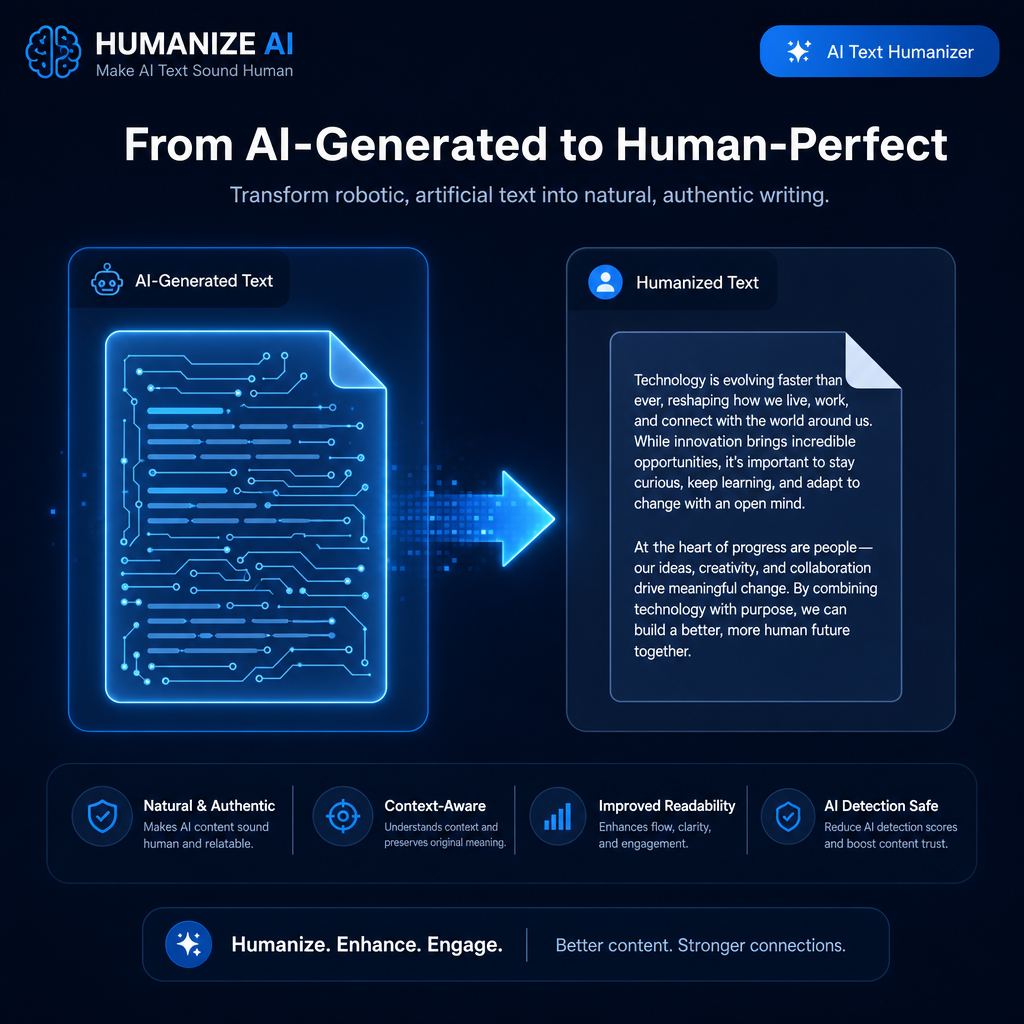
Image showing AI-generated to human-perfect content transition as part of WriteHuman AI Humanizer review
WriteHuman also ships with a built-in AI detector so you can check your humanized output without leaving the interface—the same way we have in our HumanizeAIText tool. Use it as a directional check, not gospel. Independent tests consistently show WriteHuman's internal scorer is more generous than third-party detectors like Originality.ai.
In March 2026, WriteHuman launched a REST API for teams that need to integrate humanization into production workflows. The API supports 40+ languages, returns quality scores, and generates multiple variations per request on the Premium tier. If you're running a content operation at scale, the API changes the value proposition compared to copy-paste workflows.
Is WriteHuman AI legit? Yes. It's a real product with a paying customer base and active development. The Trustpilot profile shows 218 reviews with a 4-star average. It's not a scam. But "legit" and "effective for your use case" are different questions.
WriteHuman pricing in 2026: What You Actually Pay Per Word
Every WriteHuman review lists the plan prices. None of them calculate what you actually pay per 1,000 words. That number matters, because the per-request word caps and monthly request limits mean your effective cost varies dramatically depending on how you use the tool.
Here's the math based on WriteHuman's current pricing page:
| Plan | Monthly Price | Words per request | Requests per month | Max monthly words | Cost per 1,000 words |
|---|---|---|---|---|---|
| Basic | $9 | 600 | 80 | 48,000 | $0.19 |
| Pro | $12 | 1,200 | 200 | 240,000 | $0.05 |
| Ultra | $36 | 3,000 | Unlimited | Unlimited | $0.04+ |
At face value, the Pro plan looks like a strong value at $0.05 per 1,000 words. But here's the catch: you'll almost never hit the theoretical max. WriteHuman's output quality drops noticeably on inputs longer than 800 words per request.
Multiple testers, including the WebSEOTrends 53-test study, recommend chunking content into 400-500 word segments for the best results. That means a 2,000-word blog post eats four or five requests, not two.
The Basic plan at $9/month is the real bottleneck. 80 requests at 600 words each sounds reasonable until you realize a single long article could burn 5-6 requests. A content team publishing 15-20 posts per month will hit the ceiling fast.
My take: The Pro plan at $12/month is the only tier worth considering for regular use. The Basic plan is too restrictive for anything beyond occasional personal use, and the Ultra plan at $36/month puts you in range of competitors that offer better detection bypass rates.
How WriteHuman's Pricing Compares To Alternatives
Price alone doesn't tell the story. A tool that costs $9/month but fails Originality.ai 80% of the time is more expensive than a $15 tool that passes consistently, once you factor in the editing time you'll spend cleaning up flagged content.
Here's how it stacks with other similar services:
| Tool | Starting price | Effective cost per 1,000 words | Word limit |
|---|---|---|---|
| WriteHuman Pro | $12/month | ~$0.05 | 240,000/month |
| HumanizeAIText.ai | Free tier + paid | Varies by plan | Flexible |
| Undetectable AI | $14.99/month | ~$0.06 | 10,000/month |
| StealthGPT | $24.99/month | ~$0.05 | Unlimited |
| HumanizerPro | $9/month | ~$0.04 | Up to 1 million/month |
Detection Bypass Rates: Where WriteHuman Passes And Where It Fails
This is the section that actually matters for your buying decision. I've synthesized data from the WebSEOTrends 53-run test, the BypassGPT review, the Originality.ai independent test, and the HumanizerPro test to give you the most complete picture available.
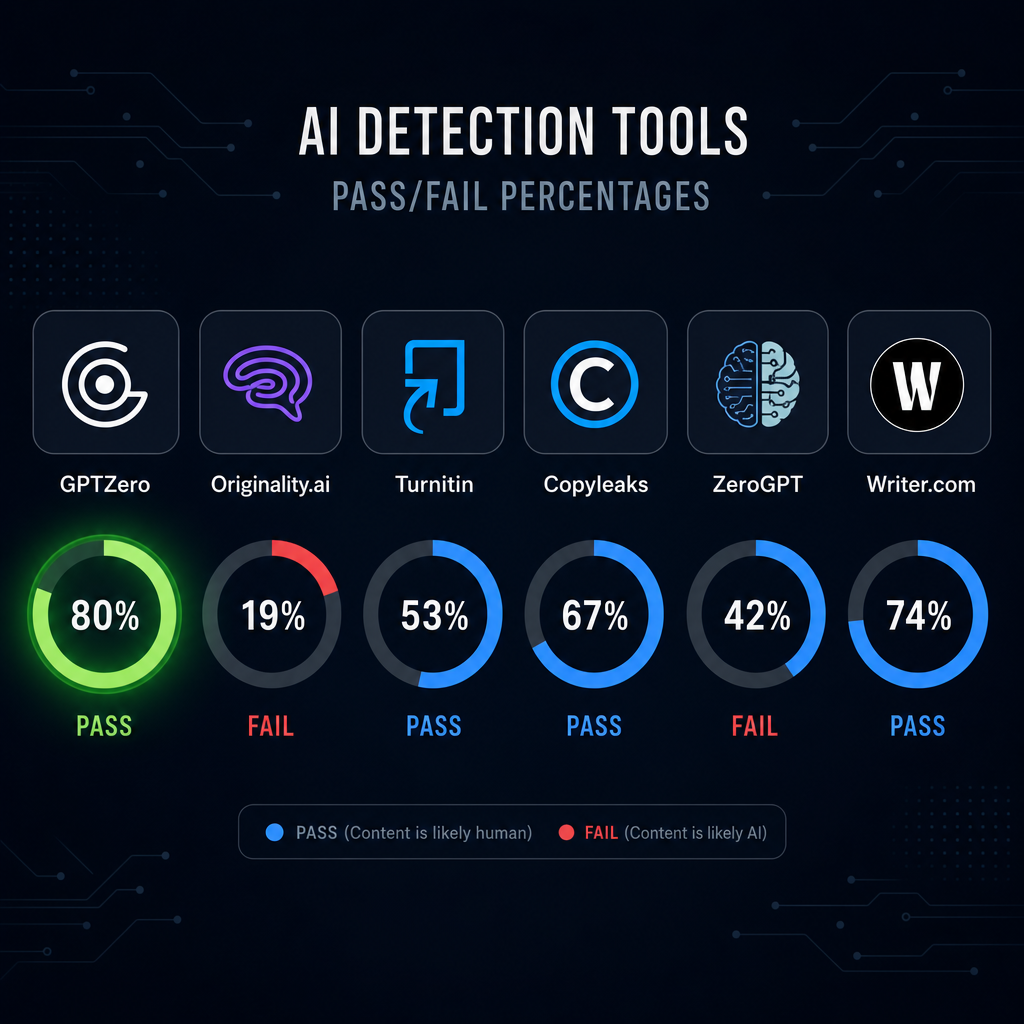
detection bypass comparison for WriteHumanAI review
Here is how WriteHuman performs across different AI detectors:
- GPTZero: Approximate pass rate is ~80%. WriteHuman's strongest result. Reliable for short blog content under 800 words.
- Writer.com: Approximate pass rate is ~85%. Passes consistently. Writer is one of the easier detectors to bypass.
- ZeroGPT: Approximate pass rate is ~70%. Mixed results. Some tests show near-0% AI scores, others flag 20%+.
- Originality.ai: Approximate pass rate is ~19%. This is the dealbreaker. Fails consistently on content over 400 words.
- Copyleaks: Approximate pass rate is ~25%. Failed outright in HumanizerPro's test (100% AI score). Unreliable.
- Turnitin: Approximate pass rate is ~30%. Not reliable for academic submissions. Grammar errors make it worse.
Can WriteHuman bypass Turnitin? Not reliably. Independent tests show a pass rate around 30%, and WriteHuman introduces grammatical errors into roughly one out of every three paragraphs of academic content. For students, that creates a double problem: your paper may still get flagged for AI origin, and it now also contains errors that weren't in your original draft.
The GPTZero performance is genuinely strong for a $12/month tool. If your only requirement is passing GPTZero on short-form content, WriteHuman works. But the Originality.ai failure rate is the number that should drive your decision.
Originality.ai is rapidly becoming the default verification tool for agencies, publishers, and serious content operations. A 19% pass rate against it means WriteHuman is effectively useless for professional client work where Originality.ai is the gatekeeper.
How Bad Humanization Kills Your SEO Rankings
Here's the angle every other WriteHuman review misses entirely: what happens to your search rankings when you publish humanized content that's poorly rewritten?
Research shows that effective humanization can improve SEO rankings, while less effective tools may cause a drop in keyword rankings. This isn't theoretical. When a humanizer introduces awkward phrasing, breaks keyword context, or inserts grammar errors, Google's quality signals pick up on it. Your content reads worse to users, dwell time drops, and rankings follow.
The stakes are higher than most people realize. 68.94% of websites now receive AI-driven traffic, which means AI-generated answers in search results are pulling clicks away from traditional organic listings. If your humanized content can't compete on quality, you're losing twice: once to the AI overview and once to competitors who publish cleaner copy.
And if you're targeting featured snippets, the bar is even higher. Featured snippets carry the highest clickthrough rate at 42.9%. Winning that position requires content that's factually precise, grammatically clean, and structured for direct answers. A humanizer that introduces errors or awkward phrasing actively works against you.
WriteHuman's keyword freeze feature partially addresses this problem. By preserving your target phrases during humanization, you avoid the common issue of losing keyword relevance in the rewrite. That's a real advantage over tools that rewrite everything blindly.
But keyword preservation alone doesn't fix tone, grammar, or readability. If you're publishing AI humanized content for SEO purposes, the humanizer needs to improve your content's readability score, not just its detection score. WriteHuman's output frequently needs a manual editing pass before it's publish-ready, and that editing time erodes the productivity gains you bought the tool for.
I've seen content teams burn two hours editing a 1,500-word humanized article because the tool swapped a technical term for a vague synonym, broke a comparison structure, or introduced a sentence fragment mid-paragraph. At that point, you're not saving time. You're adding a step.
The better workflow for SEO content: draft with AI, humanize with a tool that preserves structure and readability, then spend your editing time improving the argument rather than fixing grammar. WriteHuman gets the humanization step partially right but leaves too much cleanup on your plate for high-stakes publishing.
Output Quality: Grammar, Tone, And Readability After Humanization
Detection bypass is half the equation. If the humanized output reads like it was written by someone who learned English from a poorly calibrated language model, you still can't publish it.
WriteHuman's output quality is inconsistent. On short pieces under 500 words, the Enhanced mode produces reasonable results with natural sentence variety and decent tone. On longer content, quality degrades. Independent reviewers have documented grammar errors in roughly 30% of paragraphs, meaning drift on technical topics, and occasional nonsensical phrasing.
The Originality.ai review specifically noted that WriteHuman's output contained grammatical errors and spelling mistakes. The EssayDone review found that correcting grammar issues actually raised AI detection scores, suggesting WriteHuman deliberately introduces errors as a bypass strategy. If true, that's a design choice that directly conflicts with producing publishable content.
What real users say: WriteHuman's Trustpilot profile tells a mixed story across 218 reviews. Positive reviews praise the easy interface and fast processing. Negative reviews cluster around two themes: output that still gets flagged despite humanization, and billing/cancellation friction. Multiple users report being charged after cancellation and describe the pause/cancel process as confusing. Check the cancellation terms before subscribing.
My honest assessment: WriteHuman produces output that's good enough for casual blog posts and social media captions where a few rough edges won't matter. For client deliverables, SEO content, or academic work, you'll spend significant time editing the output. That editing time is the hidden cost that pricing pages don't show.
WriteHuman vs. The Best AI Humanizer Alternatives in 2026
Every competitor review you've read frames the alternatives section as a funnel to their own product. I'm going to give you an honest comparison across five tools, including where each one falls short.
| Tool | GPTZero Bypass | Originality.ai bypass | Price (monthly) | Best for | Biggest weakness |
|---|---|---|---|---|---|
| WriteHuman | ~80% | ~19% | $9-36 | Budget bloggers, short social content | Fails Originality.ai; grammar errors in output |
| HumanizeAIText.ai | High | High | Free tier + paid plans | SEO writers, multilingual content, document uploads | Newer brand, smaller review footprint |
| Undetectable AI | ~80% | ~44% | $14.99 | Mid-range users needing Originality.ai bypass | Output quality similar to WriteHuman on long content |
| StealthGPT | ~85% | ~78% | $24.99-34.99 | Agencies, professional publishers | Expensive; occasional over-rewriting dilutes voice |
| HumanizerPro | High | ~69% | $9 | High volume, multilingual teams | Output quality inconsistent on technical content |
My recommendation depends entirely on your use case. If you're a solo blogger publishing 5-10 posts per month and your audience doesn't run detection checks, WriteHuman's Pro plan at $12/month is fine. The GPTZero pass rate is strong enough, and the keyword freeze feature adds genuine value for SEO work.
If you're producing content for clients who verify with Originality.ai, skip WriteHuman entirely. The 19% pass rate will cost you more in revision cycles than you save on the subscription. For a complete breakdown of which AI humanization tools fit different SEO workflows, I've published a separate comparison.
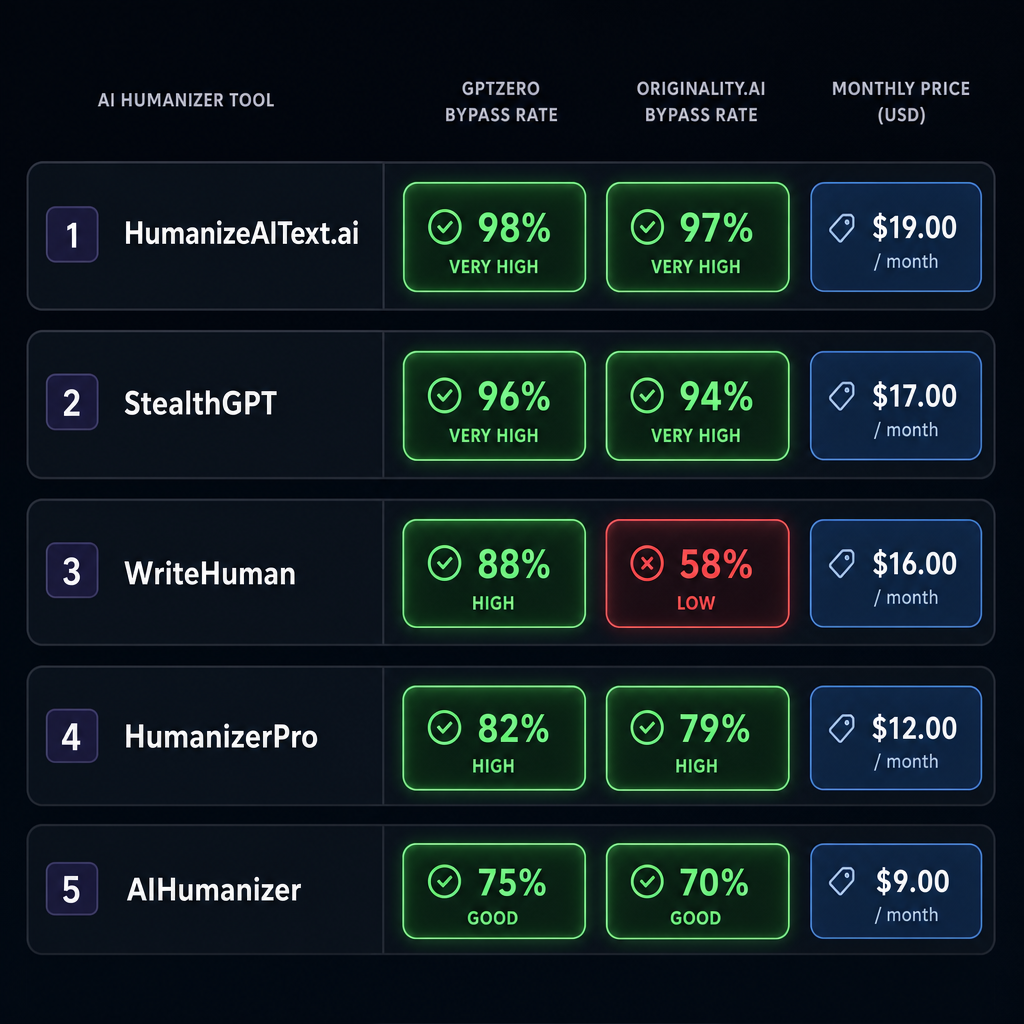
writehuman vs other AI text humanizer comparison
For academic use, I can't recommend any AI humanizer as a primary strategy. Turnitin's detection is probabilistic, trained on massive corpora, and improving faster than humanizers can keep up. The only consistently reliable approach for academic work is genuine human writing.
One pattern I keep seeing across the WriteHuman review space: every competitor publishes a "review" that gives WriteHuman a low score and then recommends their own tool. HumanizerPro gives WriteHuman 5.5/10 and pushes HumanizerPro. BypassGPT says WriteHuman fails every detector and pushes BypassGPT. The WebSEOTrends review is the most balanced of the bunch, but it still runs affiliate links.
Take every alternative recommendation with that context. The tools in the table above all have real strengths and real weaknesses. The right choice depends on which detector your audience or clients actually use, how much editing time you're willing to absorb, and whether you need multilingual support, API access, or document-format uploads.
Who Should Use WriteHuman (And Who Should Skip It)
Good fit: budget-conscious content creators
WriteHuman works well if you're a solo blogger or freelancer on a tight budget, your content primarily faces GPTZero checks, you write short-form posts under 800 words, and you're comfortable doing a light editing pass on the output.
The keyword freeze feature is a real differentiator for SEO use cases. At $12/month for the Pro plan, WriteHuman is one of the cheapest functional humanizers available.
Bad fit: agencies, students, and long-form SEO teams
Skip WriteHuman if your clients or editors use Originality.ai, you're submitting academic papers through Turnitin, you produce long-form content over 1,500 words regularly, or you need publish-ready output without a manual editing step.
The detection bypass gaps and output quality issues make WriteHuman a poor fit for these workflows. You're better served by tools that handle Originality.ai reliably, even if they cost more per month.
The billing issue deserves a separate mention. Multiple Trustpilot reviewers report confusion around what "pausing" an account actually means versus cancelling. Some describe being charged after believing they cancelled.
Before subscribing, read the cancellation terms carefully and set a calendar reminder before your next billing cycle. This isn't unique to WriteHuman, but the volume of complaints suggests the process needs improvement.
If you need to bypass AI detection consistently across multiple detectors, you need a tool that rewrites at the structural level rather than just swapping vocabulary. WriteHuman's approach works against simpler detectors but falls short against the tools that matter most for professional publishing.
Run any humanized content through an independent AI detector before publishing. Never rely on a humanizer's built-in scoring alone.
FAQs
Is WriteHuman AI legit?
Yes, WriteHuman is a legitimate product with active development, a live API, and a Trustpilot profile showing 218 reviews with a 4-star average. It is not a scam. The main user complaints relate to billing practices and inconsistent detection bypass, not the product being fake.
Can WriteHuman bypass Turnitin?
Not reliably. Independent tests show roughly a 30% pass rate against Turnitin, and the tool introduces grammar errors that can further reduce content quality. For academic submissions, no AI humanizer is a consistently reliable solution in 2026.
What is the best alternative to WriteHuman AI humanizer?
It depends on your priority. For SEO content and consistent detection bypass, HumanizeAIText.ai and Undetectable AI outperform WriteHuman on Originality.ai. For maximum bypass rates regardless of cost, StealthGPT leads with a ~78% Originality.ai pass rate. For budget users who only need GPTZero bypass, WriteHuman remains competitive.
Does WriteHuman change the meaning of your text?
On short content under 500 words, WriteHuman preserves meaning well. On longer pieces, independent tests document meaning drift and occasional nonsensical phrasing. The keyword freeze feature helps preserve critical terms, but you should always review the full output before publishing.
Is WriteHuman worth it for SEO content?
For short blog posts and social content where GPTZero is the primary check, yes. The keyword freeze feature adds genuine SEO value. For long-form content targeting competitive keywords, the grammar errors and Originality.ai failure rate make it a poor choice. The editing time required to fix output quality issues often exceeds the time you saved by using the tool.
About the Author

Dilyar Buzan is the founder and CEO of AISEO.ai, an AI-native SEO platform. With a background in AI from the University of Amsterdam, Dilyar specializes in Generative Engine Optimization (GEO), Answer Engine Optimization (AEO), and AI-driven content strategy, helping brands earn visibility across ChatGPT, Perplexity, Google AI Overviews, and traditional search. He's also co-founder of Sceneform.ai, an AI content platform for brands and creators.