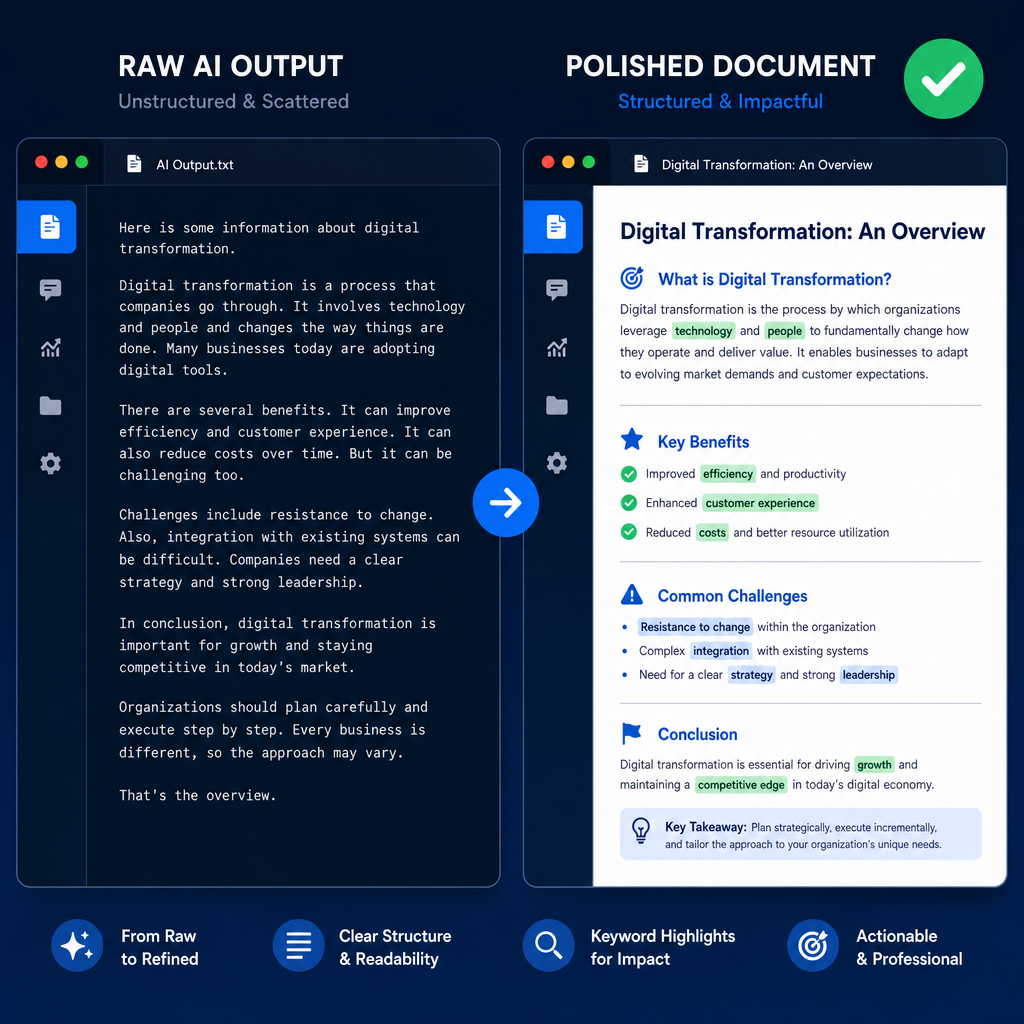
AI-generated content ranks. That's not in dispute anymore. In fact, Semrush's 2025 survey found that 39% of marketers saw organic traffic increases after publishing AI-assisted content, and 64% said it performed as well as or better than human-written content.
But 'AI-assisted content' is doing a lot of work in that sentence. The posts that rank are the ones that went through an editorial and optimization pass before publishing. The ones that don't rank were pasted in raw.
This guide covers the pre-publish SEO pass specifically: what to check, in what order, and which tools handle each layer. If you haven't cleaned your draft yet, do that first . This guide assumes the content is already through the cleanup workflow.
And if you want a deeper dive that covers every aspect of content, from outlining to publishing, check out my in-depth guide on the best AI stack for bloggers.
What Search Engines Actually Penalize in AI Content
The misconception worth clearing up first: Google doesn't penalize content for being AI-generated. John Mueller confirmed this explicitly, saying that the quality standard applies regardless of how the content was produced.
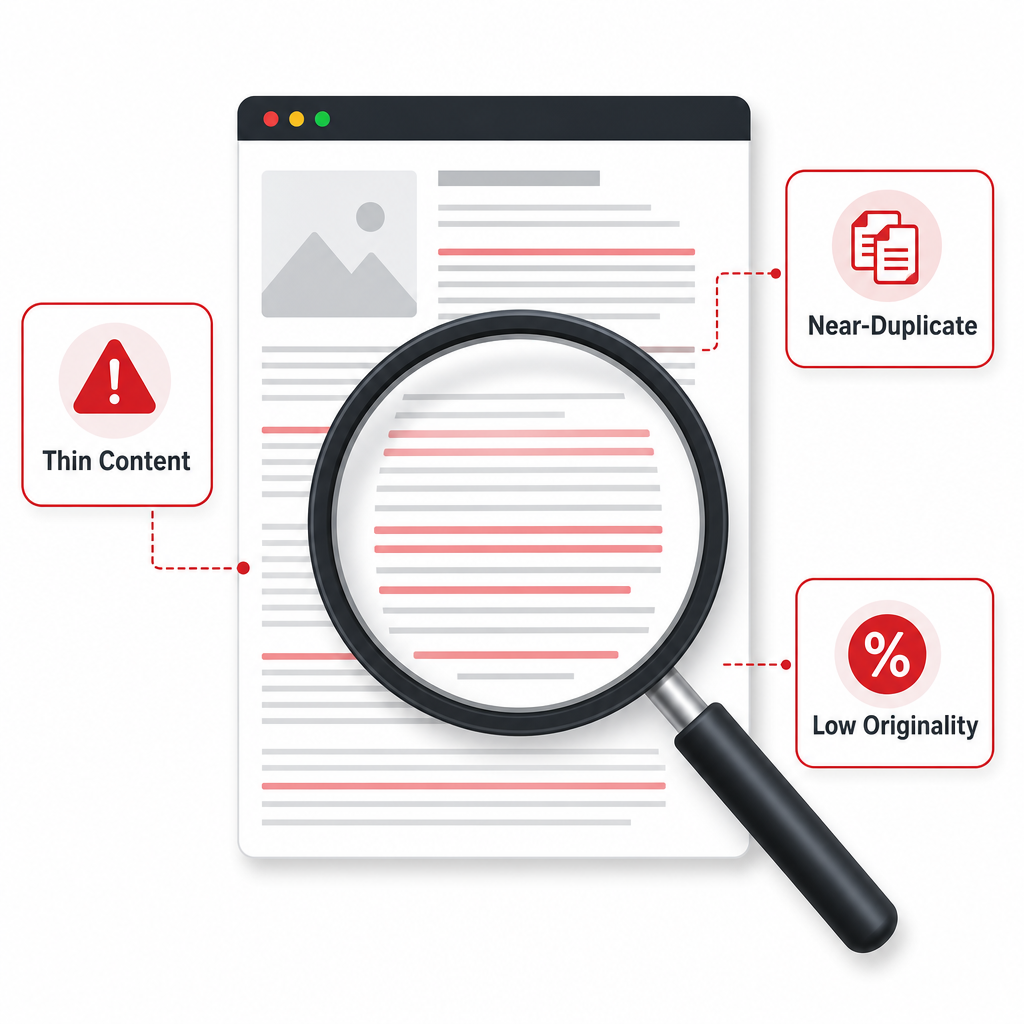
What Google does penalize is thin content, near-duplicate content, and content that fails to demonstrate expertise or originality. AI drafts fail on all three by default unless you intervene.
Thin content: AI models produce generically correct information. They summarize what's already published. Without added specifics, examples, or opinion, there's no reason for a search engine to prefer your AI post over the ten similar posts it's trained on.
Near-duplicate content: AI models trained on the same data tend to produce similar outputs on the same topic. Without an originality pass, your post may be semantically close to competitors' posts, which means the search engine has no strong reason to rank yours over theirs.
Detection risk as an SEO proxy: This one's underappreciated. AI detection scores correlate with the same statistical patterns search engines use to identify low-value content. This includes uniform sentence length, low lexical diversity, predictable transition phrases. A high detection score isn't just a credibility signal; it's a proxy for the thin-content signals you need to fix anyway.
Want a quick way to get rid of AI signs from your content? Check out this guide on how to clean up AI-generated content in under 15 minutes.
SEO structure isn't just headings. It's the machine-readable architecture of your page and the hierarchy that tells search engines what the post is about and how the sections relate to each other.
Step 1: Check and Fix the Structure
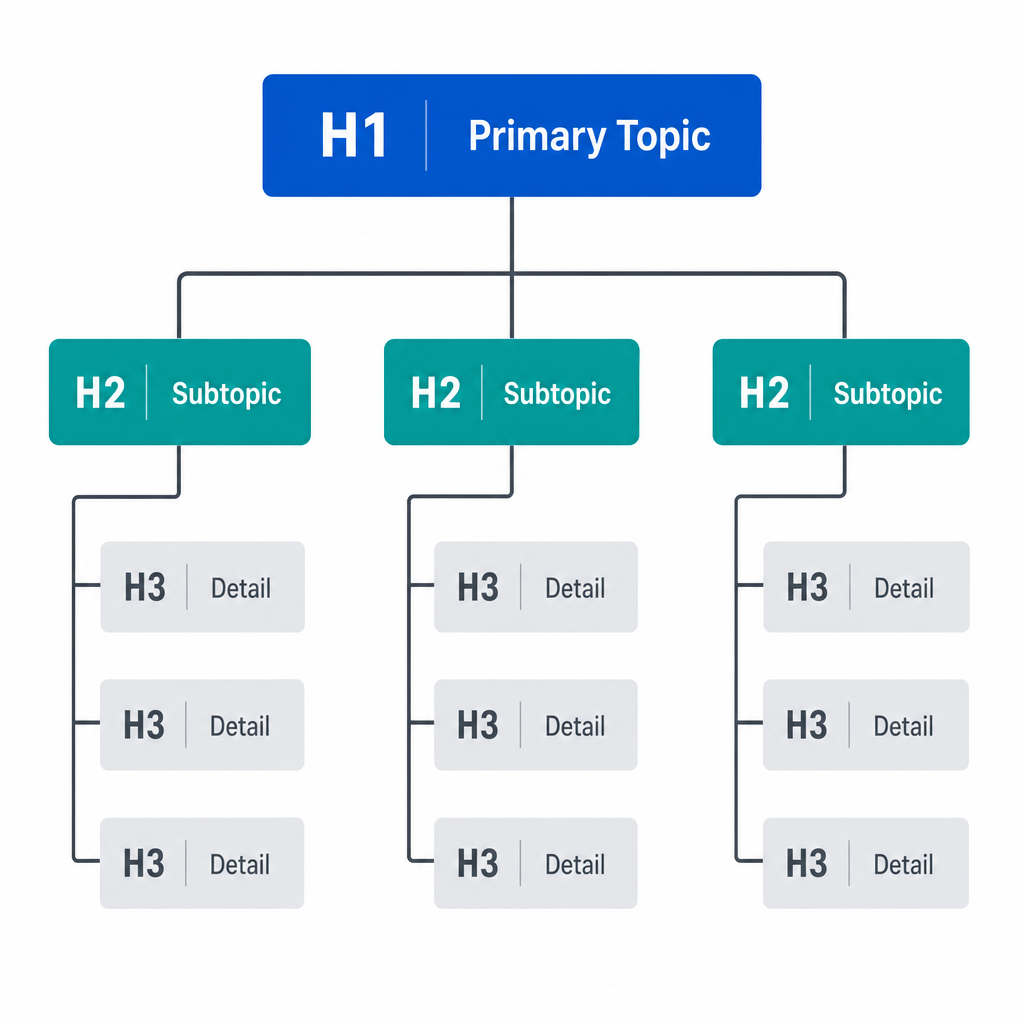
Before anything else, verify: one H1 containing the primary keyword, H2s that cover the topic's main subtopics (not just sections of your outline), H3s used for specific sub-points under H2s, and no skipped heading levels. A post that jumps from H1 to H3 sends a structural signal that the content is incomplete.
Yoast's 2026 SEO predictions made this specific: AI models rely on headings to identify topics and answers within a page. A clear heading hierarchy isn't just good for readers. It also provides the much-needed machine-readability for both search crawlers and AI Overviews.
- Rewording Tool: Rewrites headings that are vague or label-like into benefit-driven or question-form headings that align with search intent. Run your H2s through this before the keyword placement check.
Step 2: Place Keywords Intentionally; Not Aggressively
Keyword stuffing is a 2012 problem. The 2026 version of the same mistake is keyword clustering and putting the primary term in every other paragraph when it naturally belongs in maybe four or five specific places.
The targets for primary keyword placement: H1, first 100 words of body copy, at least two H2s or H3s, and the meta description. Secondary keywords belong in body paragraphs, naturally distributed across the post. Don't cluster them in one section.
For AI-generated content specifically, watch for the opposite problem: the model avoids keyword repetition to sound natural and ends up placing the primary term only once or twice in a 1,500-word post. That's under-optimization. Search engines need the term at a density of roughly 1-1.5% to understand what the post is about.
- Rewrite AI: Rewrites sections where keyword integration is off , such as either too dense, too thin, or where the phrasing around the keyword is awkward. Stronger than a simple rewording pass for structural keyword issues.

Step 3: Run an Originality Check
Originality is where most AI content optimization guides stop at 'add your own examples.' That's correct but incomplete. You also need to verify that the content is measurably distinct from what's already indexed on the same topic.
AI models trained on the same dataset produce semantically similar outputs. If three competitors published AI-assisted posts on the same keyword last month, and you publish a fourth without an originality pass, the search engine has four near-identical pieces to choose from. Your chance of ranking depends almost entirely on domain authority at that point; not content quality.
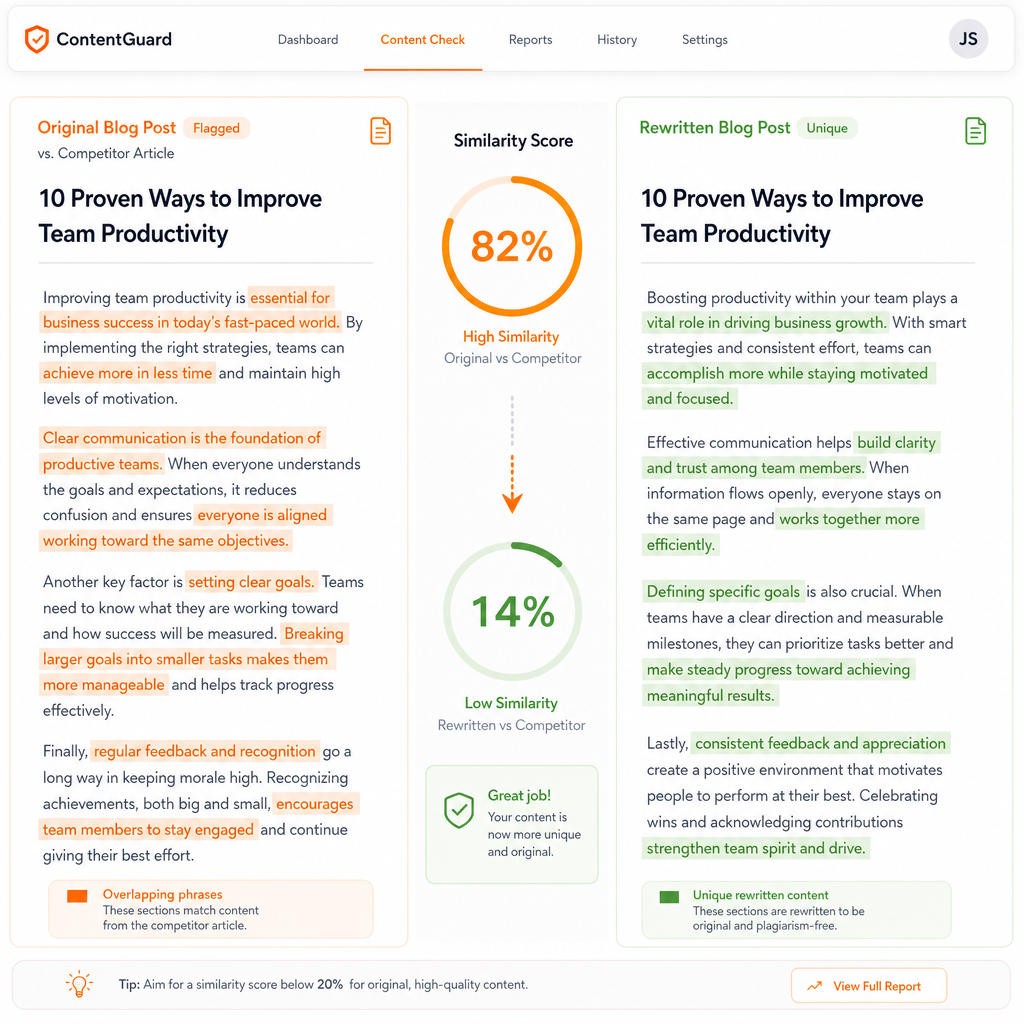
An originality check identifies which passages are too close to existing published content and gives you specific sections to rewrite before indexing.
- AI Originality Checker: Measures how distinct your content is from published content on the same topic. It’s more granular than a plagiarism checker because it flags semantic similarity, not just copied text. Run this before the plagiarism check.
- Paraphrase Generator: Rewrites flagged sections with sufficient variation to pass originality checks. Use it on the specific passages the Originality Checker flags and not on the whole post.
Step 4: Address AI Detection as an SEO Risk
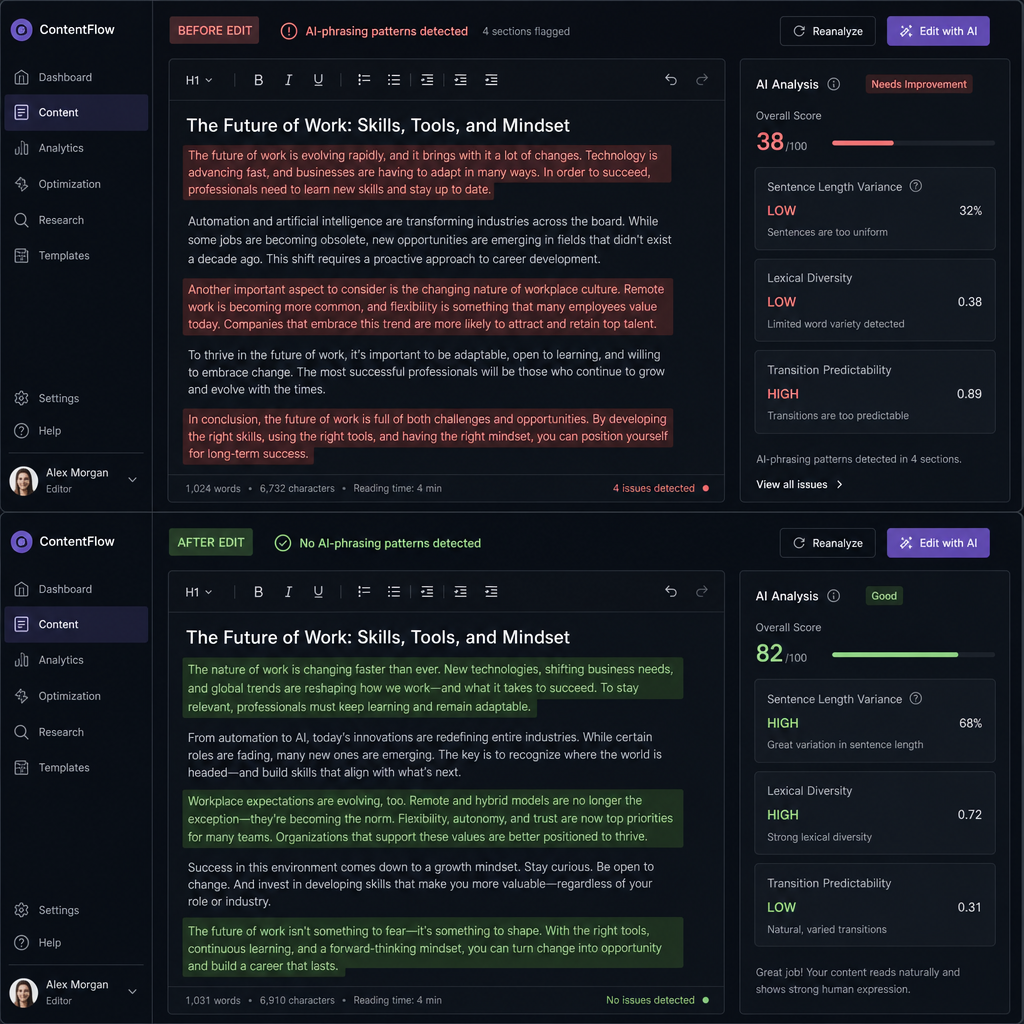
A high AI detection score on your post is worth fixing not because Google penalizes it directly, but because the phrasing patterns that detectors flag are the same ones that produce low lexical diversity and predictable sentence structure. Both of those correlate with content search engines rank lower.
Run a detection check on your post after the originality pass. Identify the flagged sections specifically. Rewrite those sections (not the whole post) to introduce more sentence variety and reduce the uniform transition patterns.
- AI Detector: Highlights which specific sections score highest for AI phrasing patterns. Use the output as a targeted editing list to rewrite the flagged sections, not the post as a whole.
- Bypass AI: Rewrites flagged sections to reduce detection scores by introducing phrasing variation, sentence length diversity, and less predictable transitions. More targeted than a full humanizer pass.
Step 5: Plagiarism Check (This is the Final Gate)
AI models paraphrase published content closely enough that a plagiarism check sometimes flags passages even after a humanization pass. This is the last check before publishing.
If passages flag, rewrite them specifically. Don't rewrite sections that didn't flag or you'll end up introducing new problems in clean sections unnecessarily.
- Plagiarism Checker: The final gate before publishing. Catches close paraphrases of source material that survived the originality and humanization passes. Required before indexing any AI-assisted content.
Step 6: Confirm Internal and External Links
Internal links tell search engines how this post relates to the rest of your site's content. Every post should link to at least two related pages on the same domain, using descriptive anchor text that reflects the linked page's topic . Please refrain from using generic terms like 'click here' or 'learn more.'
External links to authoritative sources serve a different function: they're E-E-A-T signals. Linking to primary sources (studies, official documentation, recognized publications) tells both readers and search engines that your content is grounded in real information, not just AI-generated generalizations.
The Full SEO Optimization Workflow at a Glance
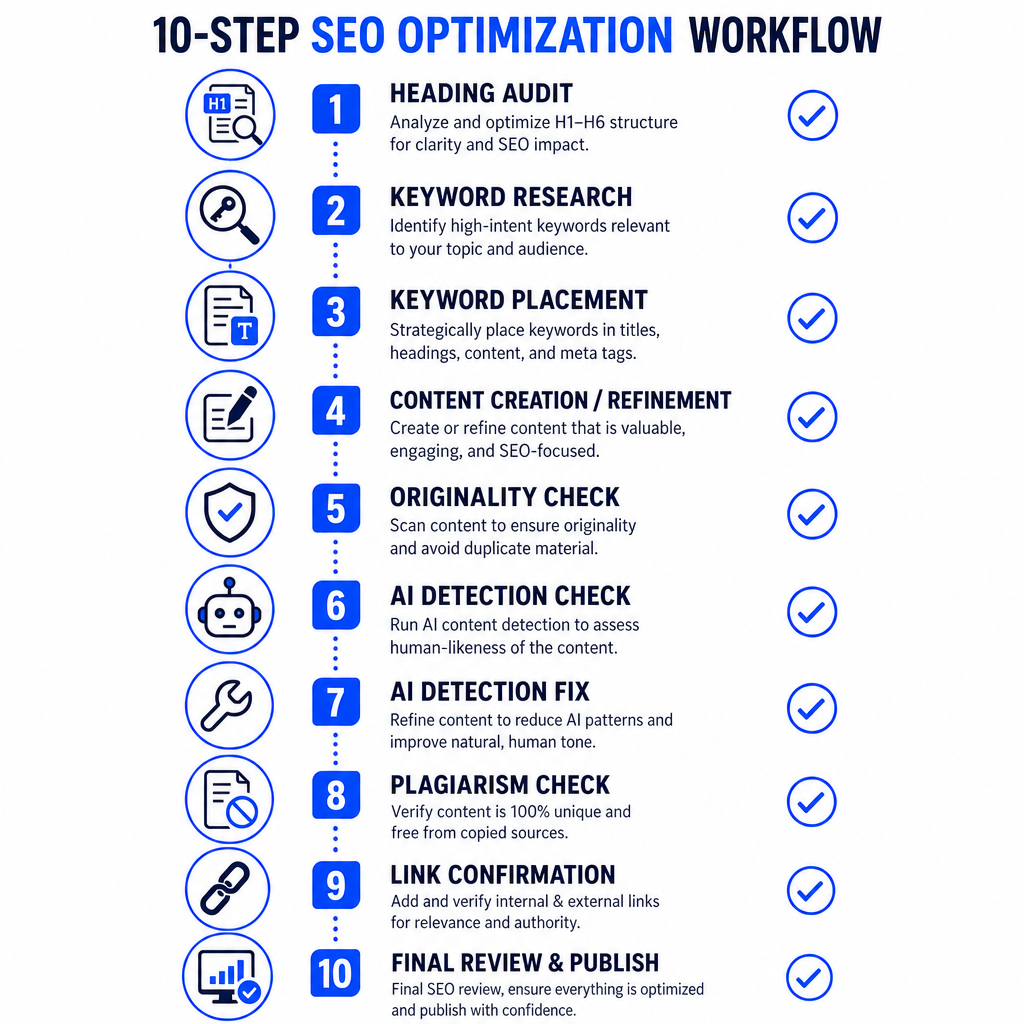
- Check heading structure: one H1, logical H2/H3 hierarchy, no skipped levels
- Rewording Tool → rewrite vague headings for search intent alignment
- Verify keyword placement: H1, first 100 words, 2+ H2s, meta description
- Rewrite AI → fix keyword integration in specific sections
- AI Originality Checker → identify semantically similar passages
- Paraphrase Generator → rewrite flagged sections
- AI Detector → identify high-detection sections
- Bypass AI → rewrite flagged sections for phrasing variety
- Plagiarism Checker → final uniqueness gate
- Confirm internal links (2+ per post) and external citations
- Chat Rank Tracker GPT -> verify whether ChatGPT surfaces the post for your target query after publishing
The full pass takes 15-20 minutes on a 1,500-word post. Done consistently, it's the difference between AI-assisted content that competes for rankings and AI-assisted content that sits on page three and generates nothing.
Once your post is optimized and published, the repurposing workflow guide covers how to extract multiple distribution assets from the same piece of content so the optimization investment compounds across formats.
Step 7: Track Whether AI Search Surfaces Your Content
Publishing does not end the SEO workflow anymore. Readers now discover answers through ChatGPT-style summaries, AI Overviews, and assistant recommendations, so a post can be technically optimized and still invisible in conversational search if the article lacks clear entities, proof, and concise answers.
After the post is live, run your target query through the Chat Rank Tracker GPT to see whether ChatGPT mentions your page, how it describes your brand, and which competing sources it prefers. Treat it like a lightweight AI visibility check alongside Search Console: if your article is missing, strengthen the section that answers the query directly, add original examples or data, and improve internal links from related pages.
This closes the loop on the pre-publish process. You are not just optimizing for keywords; you are checking whether the content is clear enough for search engines and answer engines to understand, cite, and recommend.
Frequently Asked Questions
Does Google penalize AI-generated blog content?
Google does not penalize content for being AI-generated. The quality guidelines apply regardless of how content was produced. What search engines penalize is thin content, near-duplicate content, and content lacking originality or expertise signals: all of which are common in unedited AI drafts and fixable with a pre-publish optimization pass.
How do you optimize AI content for SEO?
The pre-publish SEO optimization workflow covers six steps: fix heading structure, place keywords intentionally at the right density, run an originality check and rewrite flagged sections, address AI detection patterns that correlate with thin content signals, run a plagiarism check, and confirm internal and external links. Each step addresses a specific ranking factor that unedited AI content fails on by default.
Is AI detection a risk for SEO?
Not directly. Google has stated it doesn't use AI detection as a ranking signal. But the phrasing patterns that AI detectors flag (uniform sentence length, predictable transitions, low lexical diversity) correlate with the same content quality signals search engines use to evaluate whether content deserves to rank. Fixing detection issues effectively fixes underlying content quality issues.
What is the difference between a plagiarism check and an originality check for AI content?
A plagiarism checker identifies text that closely matches existing published content for near-verbatim copying. An AI originality checker identifies semantic similarity within passages that cover the same ground in similar ways without being direct copies. For AI content, both checks are necessary: AI models paraphrase closely enough to require the originality check, and sometimes closely enough to trigger the plagiarism check too.
How long does the SEO optimization pass take for an AI blog post?
The full pre-publish SEO optimization workflow takes 15-20 minutes for a standard 1,500-word post. This covers heading review, keyword verification, originality and detection checks, targeted rewrites of flagged sections, and link confirmation. Done consistently as part of a publishing checklist, it adds negligible time relative to the content production process.
About the Author

Bishal is a senior SEO strategist, content researcher, and AI automation expert. He builds technical SEO strategies and custom n8n workflows for AI-native agencies. He also focuses on Generative Engine Optimization (GEO) to help brands adapt and dominate in today's AI-driven search landscape.