If you spend enough time online right now, you eventually run into the same weird modern anxiety.
A student submits an essay they genuinely wrote and gets flagged as "90% AI." A marketer runs a blog post through three detectors and gets three completely different answers. A freelancer edits a draft for hours, only to watch an AI checker call it "machine-generated" anyway.
At this point, AI detection has become its own little digital ghost story. Everyone talks about it. Nobody fully trusts it. And yet schools, agencies, publishers, and businesses continue using these tools to make real decisions.
That's why so many people are searching “what is an AI detector” and “how AI detection actually works”.
The strange part is that most explanations online barely explain anything. They usually recycle the same vague phrases about "advanced algorithms" and "machine learning analysis" before dumping a giant list of tools with pricing tables large enough to qualify as architecture.
The reality is more interesting than that.
AI detectors are not plagiarism checkers. They are not truth machines. They are not capable of proving authorship. What they actually do is analyze statistical language behavior and estimate whether a piece of writing resembles patterns commonly produced by large language models like GPT-4, Claude, or Gemini.
That distinction changes everything because once you understand what detectors are really measuring, you also understand:
- Why human writing gets flagged
- Why AI writing often feels "too clean"
- Why detectors contradict each other constantly
- Why heavily edited content still triggers warnings
- And why no detector can ever be perfectly reliable
Understanding AI detectors today is less about software and more about understanding how language behaves when humans write versus when machines predict text statistically.
What Is an AI Detector?
An AI detector is a software system designed to estimate whether text was written by a human or generated using artificial intelligence.
Notice the wording carefully: estimate.
Most people assume AI detectors work like plagiarism software. That assumption is completely wrong.
Plagiarism tools compare your writing against existing sources. If a sentence matches another document, the software flags it. The process is relatively straightforward.
AI detectors do something far more abstract.
Instead of comparing your text to published material, they analyze patterns inside the writing itself. They examine:
- Sentence rhythm.
- Predictability.
- Structural consistency.
- Token probability.
- Phrasing patterns.
- Paragraph balance.
- Linguistic variation.
The detector then calculates how closely those patterns resemble writing commonly produced by language models.
This means the output is never certainty. It is always probability.
When a detector says "Likely AI," "Mostly Human," or "Possibly AI-assisted," it is making a statistical judgment, not discovering objective truth.
That's also why two detectors can completely disagree about the same piece of writing. They are not reading your mind. They are measuring different linguistic signals using different scoring systems.
Once you realize this, the entire AI detection industry starts making much more sense.
How AI Detectors Identify AI-Generated Content
Most modern AI detectors rely on several core concepts from computational linguistics and probability modeling.
Underneath the glossy dashboards and dramatic "AI probability" scores, detectors are essentially trying to answer one question: Does this text behave like human writing or like statistically optimized machine output?
To answer that, they examine a combination of signals.
Perplexity Analysis
Perplexity is one of the most important concepts in AI detection.
In simple terms, perplexity measures how predictable a sequence of words is. According to research published in Transactions of the Association for Computational Linguistics, perplexity-based scoring remains one of the most consistent features distinguishing LLM-generated text from human-written content — even when surface-level style varies significantly.
Large language models are trained to generate statistically likely next words. As a result, AI-generated writing often flows very smoothly. Sentences feel balanced. Word choices feel safe. Transitions feel clean.
Human writing is messier.
People interrupt themselves. They over-explain random details. They choose weird phrasing. They suddenly shorten sentences when emotional. They drift. They repeat themselves accidentally. They take linguistic detours because their brain moved faster than the sentence.
Human writing has irregularity baked into it. AI writing tends to optimize that irregularity away.
If a paragraph feels too statistically predictable across a long sequence of text, the AI probability score rises. Ironically, the better AI models become at sounding polished, the more they sometimes trigger detectors.
Burstiness Measurement
Burstiness measures variation in sentence structure and rhythm.
Humans rarely write with perfectly balanced pacing. We naturally mix short sentences, long winding explanations, fragments, abrupt transitions, and uneven paragraph structures.
AI models, especially older ones, often distribute sentence complexity too evenly. Imagine two people walking down a street. One walks naturally: slow, fast, pause, speed up, stop to check something, continue. The other walks at the exact same speed for twenty minutes straight like a background NPC in a low-budget video game.
That second rhythm feels artificial instantly. Detectors look for the linguistic equivalent of that robotic pacing. Low burstiness often correlates with AI-generated text.
Token Probability Modeling
Language models generate writing token by token. A token can be a word, part of a word, punctuation, or other small language units.
When AI produces text, it selects tokens based on probability distributions learned during training. Detectors reverse-engineer this behavior. They examine whether your wording aligns too closely with statistically common language model outputs.
If sentence after sentence follows highly probable constructions, the detector may interpret the text as machine-generated. This is also why heavily templated SEO content sometimes gets flagged even when humans wrote it. Over-optimized writing starts behaving statistically like AI.
Structural Consistency
AI loves clean structure. Perfect transitions. Even paragraph sizes. Linear progression. Balanced explanations.
Humans are less disciplined. Real writing contains tiny imperfections: uneven emphasis, awkward pivots, overdeveloped sections, rushed conclusions, personal detours, inconsistent energy.
Detectors often interpret excessive structural symmetry as a machine signal, which creates one of the stranger outcomes in modern writing. A heavily edited, perfectly optimized human article can sometimes look more AI-generated than an actual AI draft.
Why Human Writing Gets Flagged as AI
This is where most discussions about AI detection completely fall apart. People often assume: "If my writing was flagged, the detector must be accurate." Not necessarily.
Human writing gets flagged constantly, and usually for understandable reasons.
Overediting Removes Human Texture
When people aggressively polish their work, they often remove the very irregularities detectors associate with humans. The result becomes grammatically perfect, structurally balanced, tonally stable, highly predictable, and statistically smooth, which looks suspicious to detectors.
Grammarly and Editing Tools Can Trigger AI Signals
Modern grammar tools increasingly rewrite text for clarity and consistency. That sounds harmless until you realize those systems often optimize writing using patterns similar to AI models.
After enough editing passes, authentic human writing can become linguistically "flattened." The text stops sounding like a person thinking through ideas in real time and starts sounding like optimized output.
If you're using Humanize AI after a heavy Grammarly pass, this is the exact problem it's designed to reverse: restoring the natural variation that over-polished text loses. You can learn more about specific editing strategies in this guide on how to clean up AI-generated content.
SEO Writing Creates Predictable Structure
SEO content tends to follow highly standardized frameworks: clean H2 structures, keyword repetition, consistent readability, balanced paragraph length, predictable transitions. These structures are excellent for readability. They also sometimes resemble AI-generated formatting patterns.
This creates a bizarre modern scenario where SEO best practices, editing software, readability optimization, and AI detectors all push writing in conflicting directions. If you work in content at scale, the best AI stack for bloggers breaks down how to use these tools without triggering one against the other.
Non-Native English Writers Get Hit Hard
This issue rarely gets enough attention. A 2023 Stanford study found that automated writing detection tools disproportionately flag essays written by non-native English speakers... in some cases at more than twice the false positive rate of native writers.
Many non-native English writers intentionally simplify sentence structure to improve clarity and correctness. Unfortunately, simplified and highly controlled writing can sometimes resemble low-perplexity AI output.
As a result, genuine human work occasionally gets flagged unfairly. This is one of the biggest legitimacy crises in modern AI detection.
Are AI Detectors Actually Accurate?
Short answer? Not consistently.
Some detectors are better than others. Some are stricter. Some are more conservative. Some produce false positives constantly. But none are definitive.
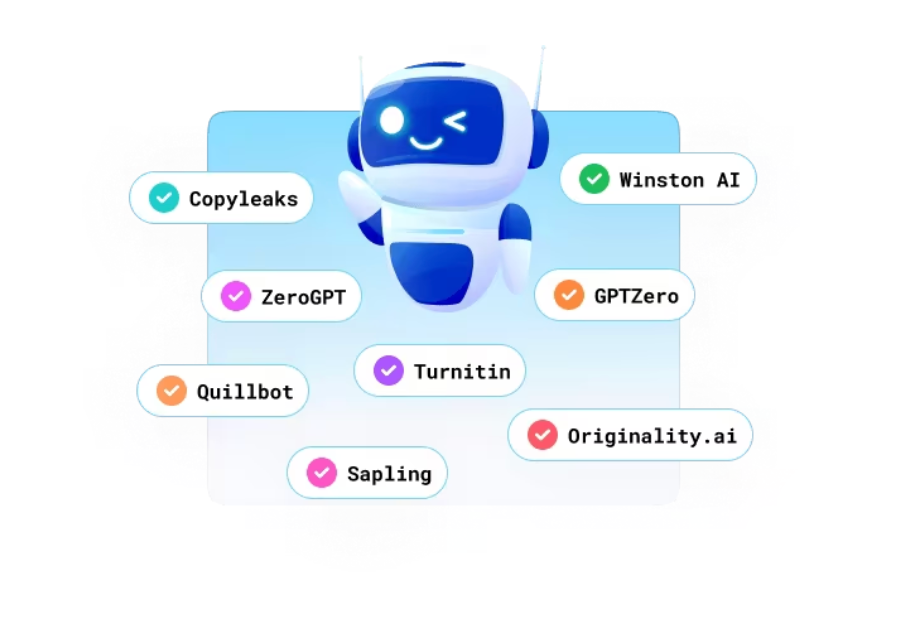
You can paste the same paragraph into GPTZero, Originality.ai, Copyleaks, Winston AI, and Turnitin — and receive wildly different scores. That's because detectors are not measuring objective truth. They are interpreting statistical signals using different thresholds and datasets.
A detector might score a passage as 95% AI while another labels it "Mostly Human." Both systems may technically be behaving exactly as designed.
This inconsistency is why many educators, editors, and publishers increasingly treat AI detectors as advisory tools rather than final judgment systems. The software can identify suspicious patterns. It cannot prove authorship. That distinction matters enormously.
Before flagging anyone based on a detector score, the smartest thing to do is run the content through Humanize AI's free AI detector yourself. It gives you a second opinion fast, and it's one of the more calibrated tools on the market.
The Biggest AI Detectors Right Now (In No Particular Order)
- AISEO – Best all-in-one tool for humanized, SEO-ready content
- Humanize AI – Best for making AI-written text sound genuinely human
- GPTZero – Best known AI detector in education
- Originality.ai – Best for publishers and SEO teams checking AI content at scale
- Copyleaks – Best for enterprise and academic compliance
1. AISEO: Best Overall Platform for Humanized + SEO-Ready Content
AISEO goes beyond detection avoidance. It combines humanization, SEO intelligence, plagiarism scanning, and long-form rewriting into one system. While Humanize AI focuses purely on statistical human patterns, AISEO balances human feel with search performance.
AISEO is widely used by content teams, niche site builders, and agencies that care about ranking as much as authenticity. Its humanize engine reduces AI signals while its Outrank feature analyzes top-ranking pages to guide structure and depth. This dual focus makes AISEO one of the most complete tools available.
The platform is especially effective for blogs, landing pages, and informational content where clarity, authority, and natural tone all matter. AISEO does not just make text harder to detect. It makes it more competitive.
AISEO
Key Features of AISEO
1. Humanize Engine
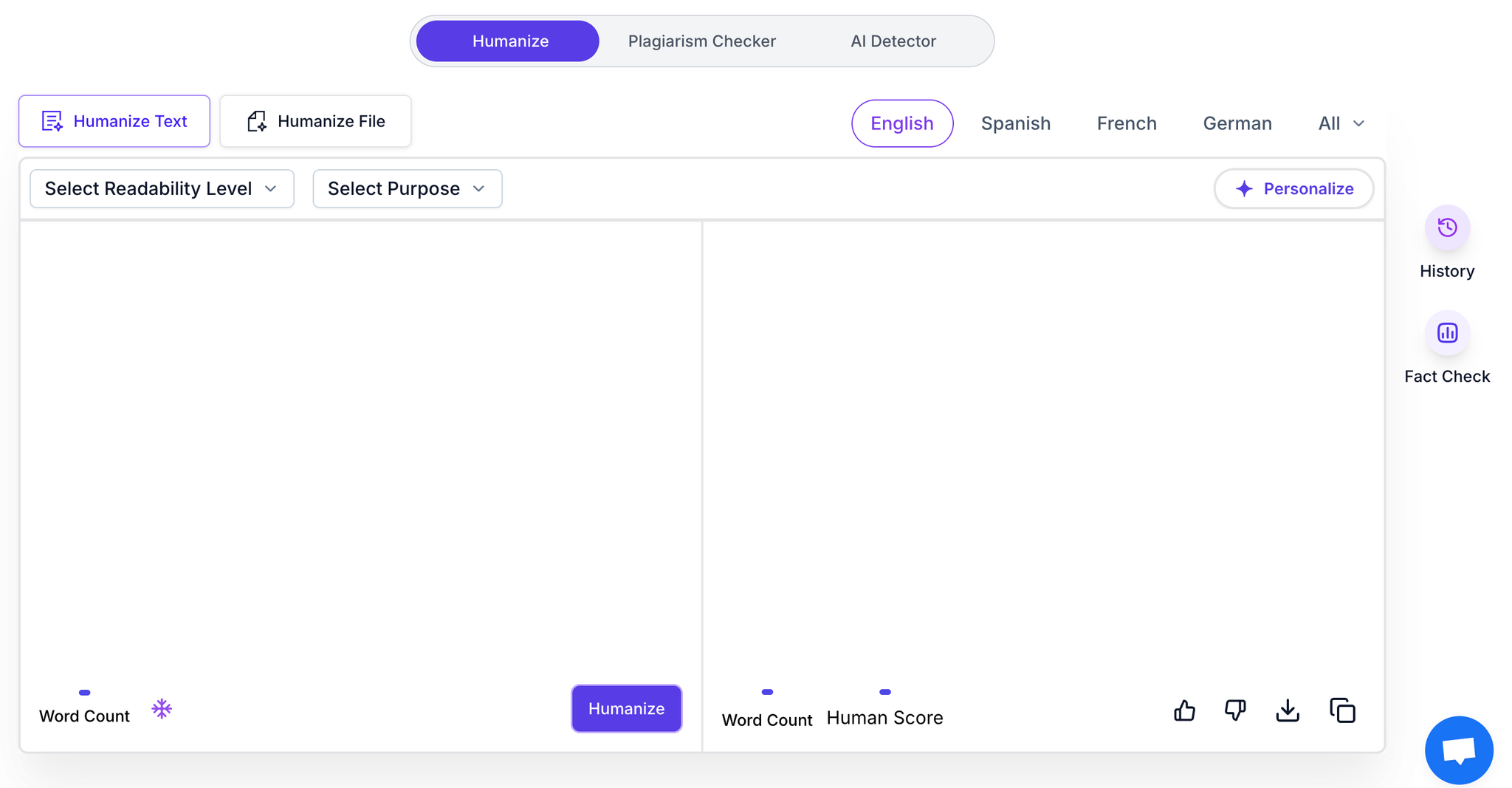
AISEO’s Humanize Engine rewrites content by targeting the statistical patterns that AI detectors measure, not just surface-level wording. It adjusts sentence rhythm, varies structure, and reduces predictability while preserving the original voice and intent. Instead of making text sound artificially casual or over-edited, the engine focuses on natural flow. This helps content read like it was written by a real person, while lowering detection risk across common AI detection tools.
Humanize Engine
2. Outrank SEO Analysis
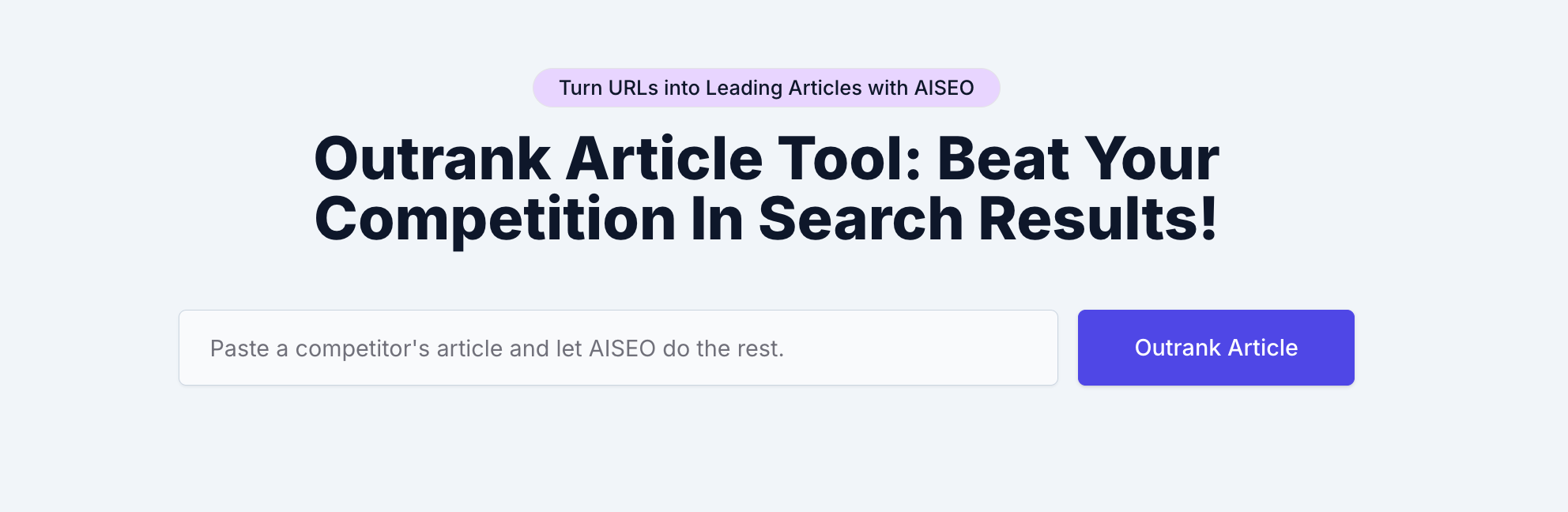
Outrank is AISEO’s standout SEO feature. It analyzes top-ranking pages for a target keyword and breaks down their structure, depth, and search intent. Rather than guessing what to write, users get clear guidance on headings, topic coverage, and content gaps. This moves AISEO beyond paraphrasing into strategic content creation, helping writers produce articles that are not only human-sounding but also competitive in search results.
Outrank SEO Analysis
3. Plagiarism Detection and Fixing
AISEO includes built-in plagiarism scanning that checks for duplicated or high-risk phrasing. When issues appear, the platform rewrites only the problematic sections while keeping the surrounding context intact. This avoids the common problem of breaking tone or meaning during cleanup. For students, bloggers, and agencies, this feature reduces the need for separate plagiarism tools and ensures content stays original, consistent, and publication-ready.
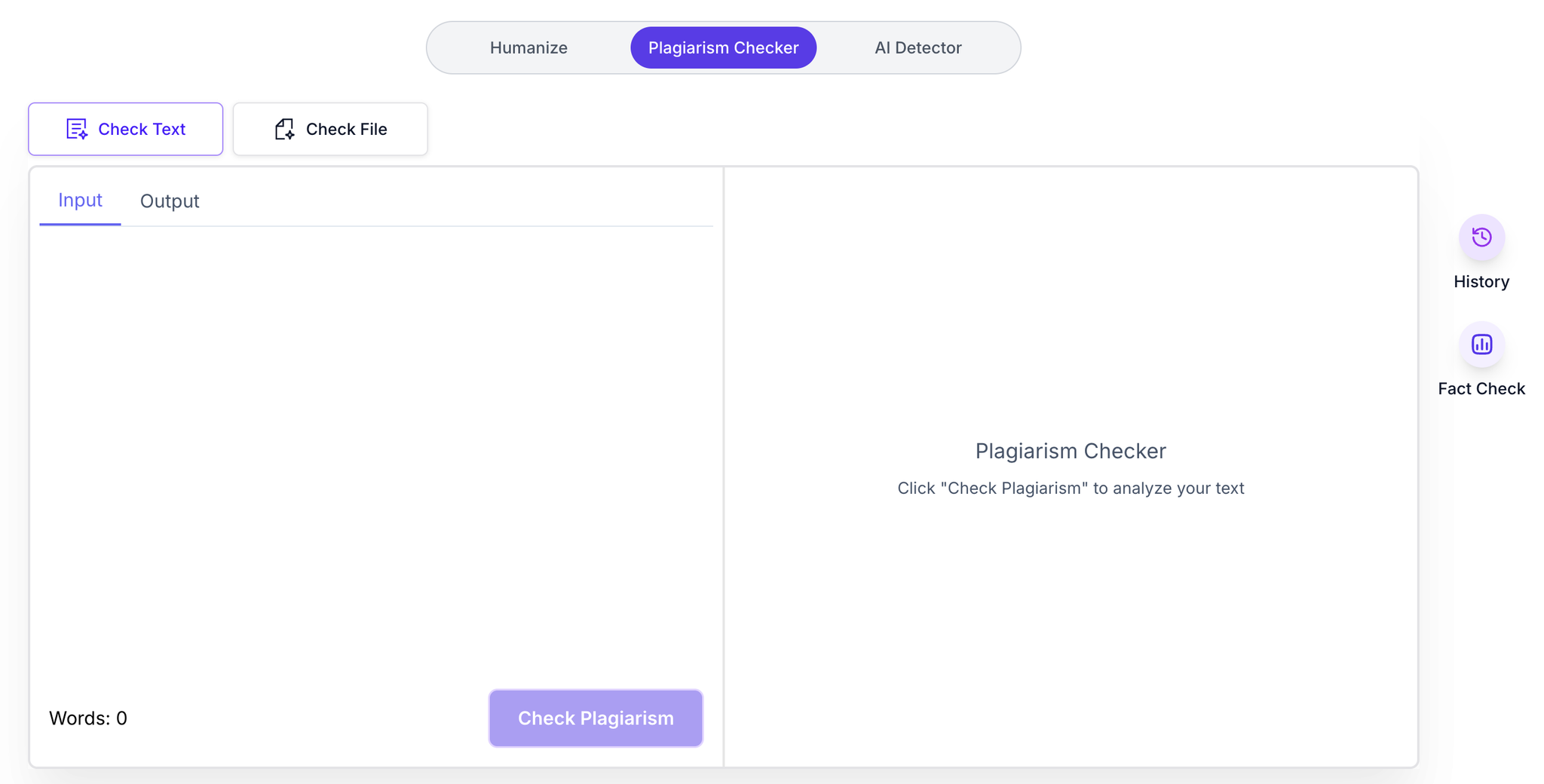
Integrated Plagiarism Checker
AISEO Pricing
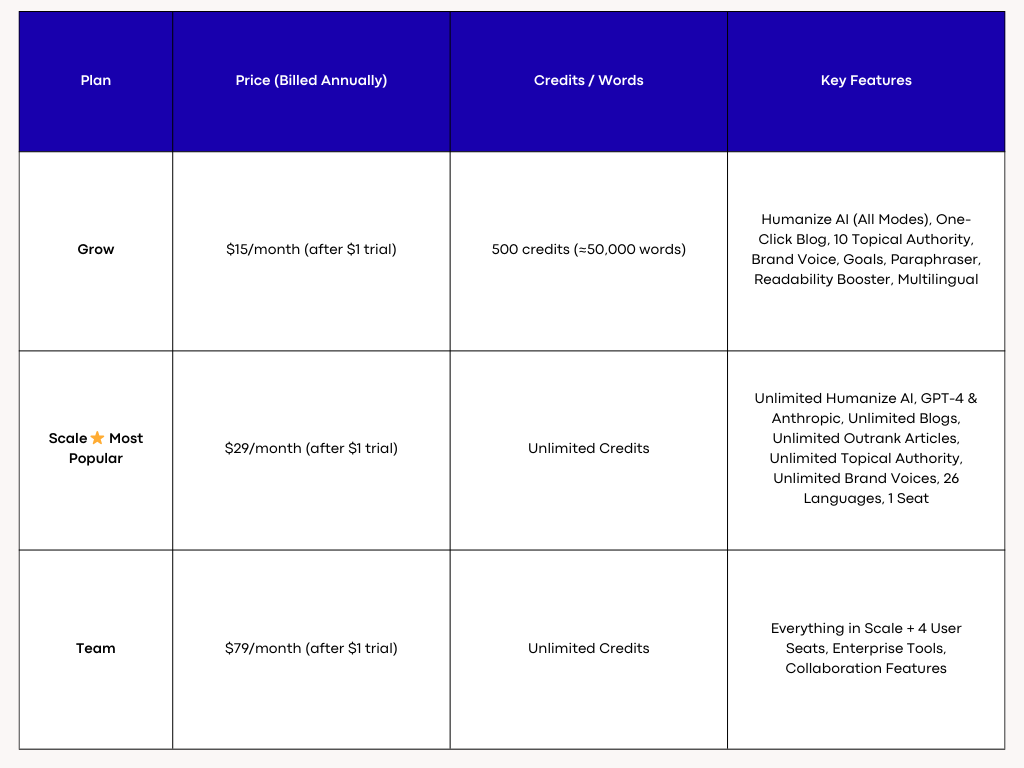
AISEO Pricing Table

AISEO Pricing
2. Humanize AI: Best for Natural, Human-Level Rewriting
Humanize AI is designed for one purpose: removing statistical AI patterns from text while preserving meaning. Unlike basic paraphrasers that rely on synonym replacement, Humanize AI restructures sentences at a deeper level. It adjusts rhythm, varies sentence length, and rewrites transitions so the content reflects human writing behavior rather than model-generated predictability.
This tool is widely used by students, freelancers, bloggers, and agencies who need writing that feels authentic and passes human review. Humanize AI focuses on how text flows rather than just what words are used. That distinction is crucial. AI detectors do not flag vocabulary. They flag patterns.
Users typically notice that the output feels less polished but more believable. That slight imperfection is exactly what lowers detection risk. Humanize AI is especially effective for essays, blogs, reports, and long-form content where consistency matters.
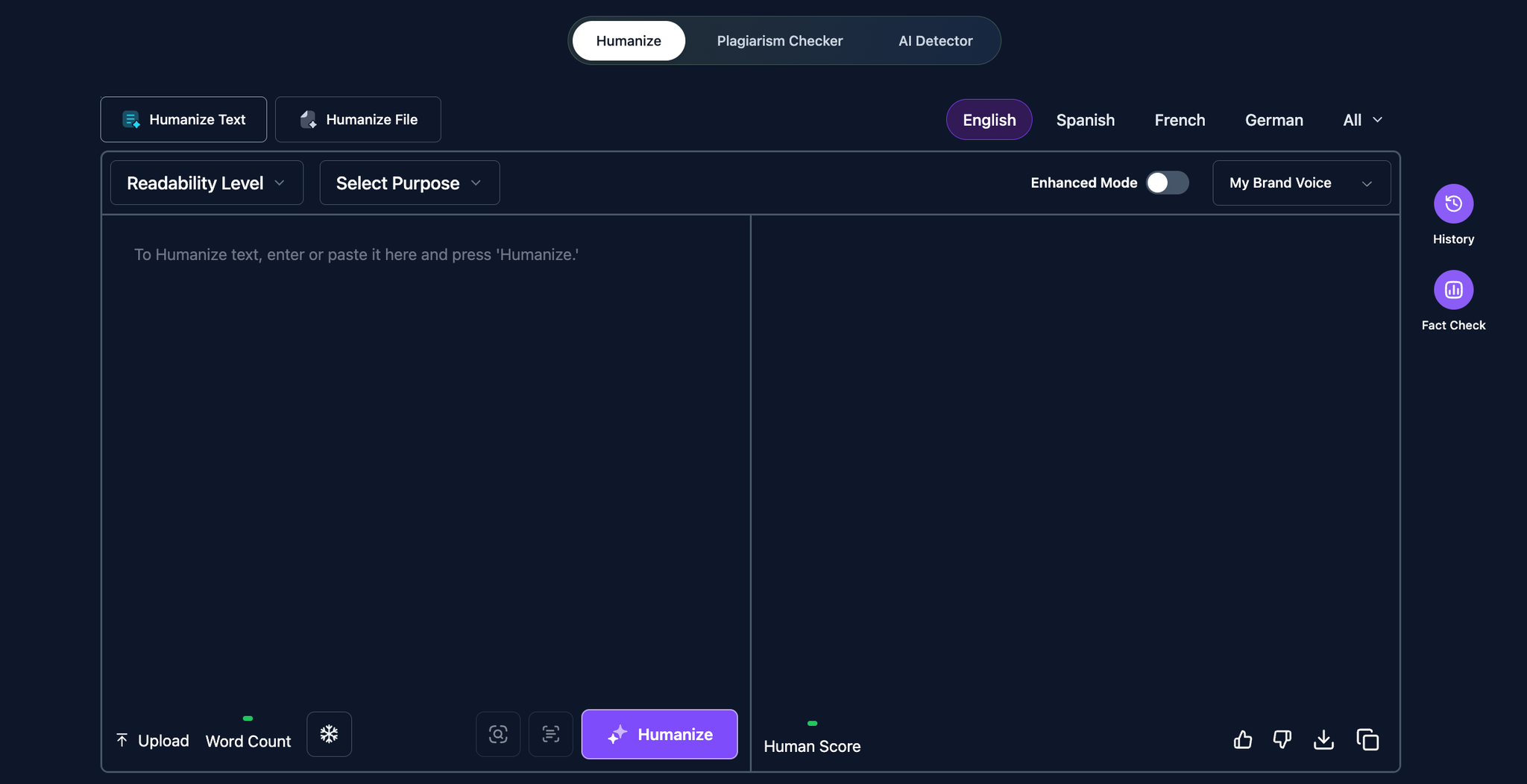
Humanize AI Text
Key Features of Humanize AI
1. Structural Humanization
Humanize AI rewrites sentence architecture rather than swapping words. It varies clause order, sentence length, and logical flow to reduce predictability. This directly targets perplexity and burstiness signals used by detectors.
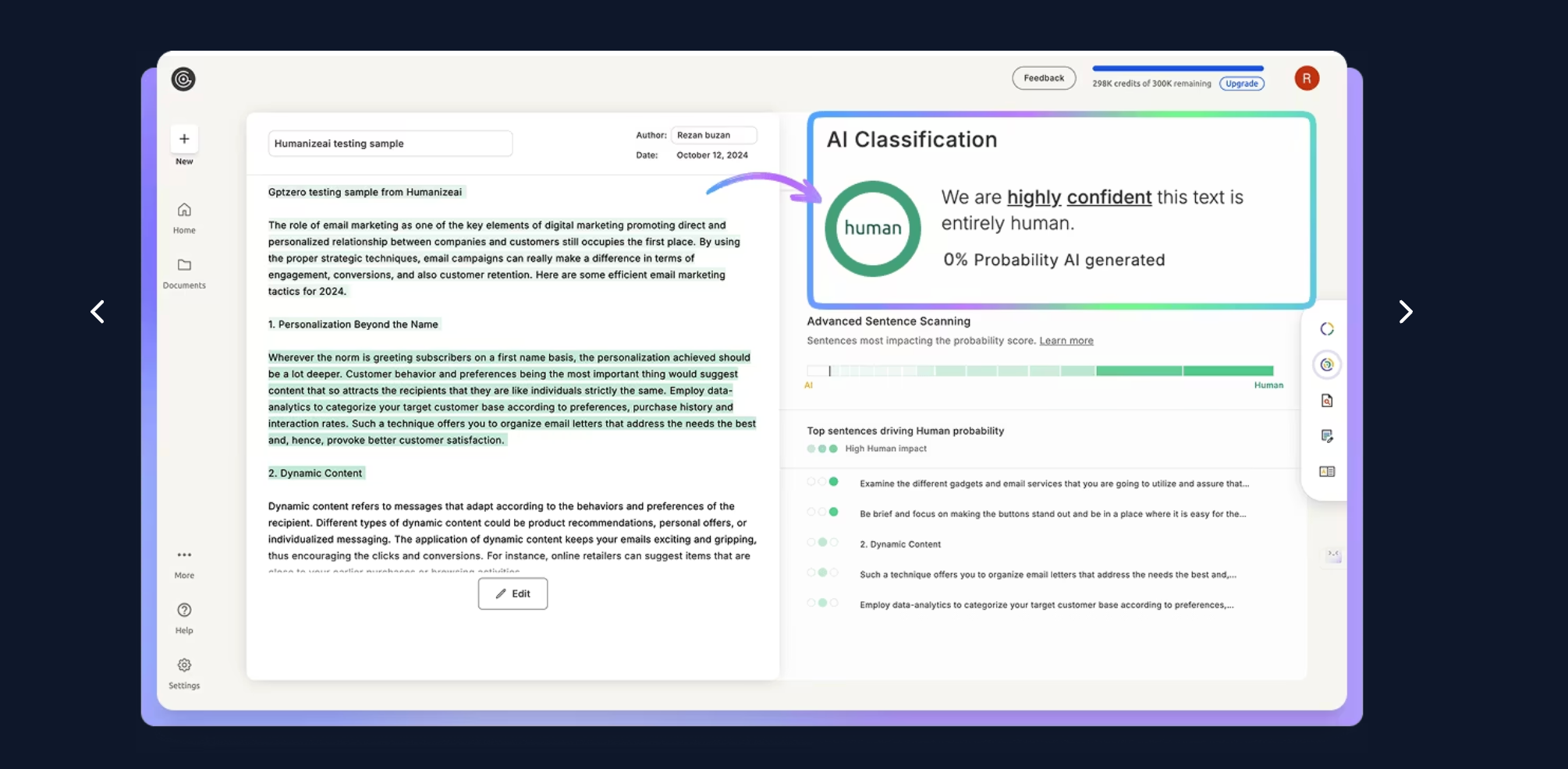
Structural Humanization
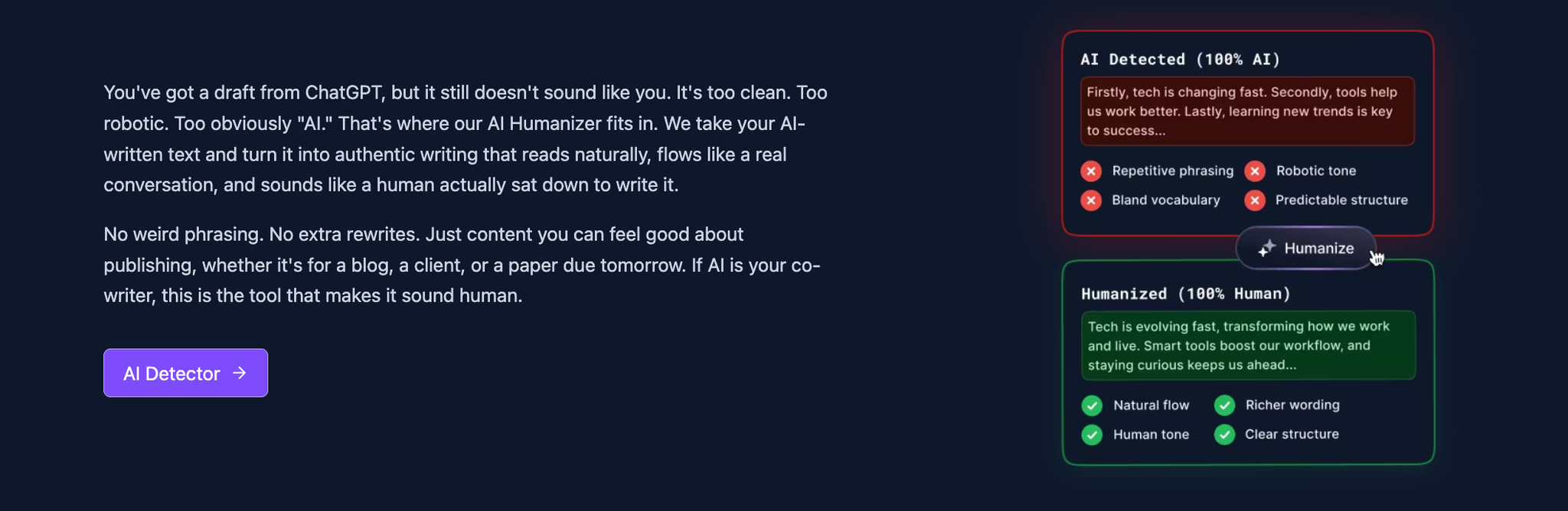
2. Rhythm and Flow Adjustment
The tool introduces natural pauses, uneven pacing, and human-like transitions. These subtle changes significantly reduce AI-like smoothness without harming readability.
Rhythm and Flow Adjustment
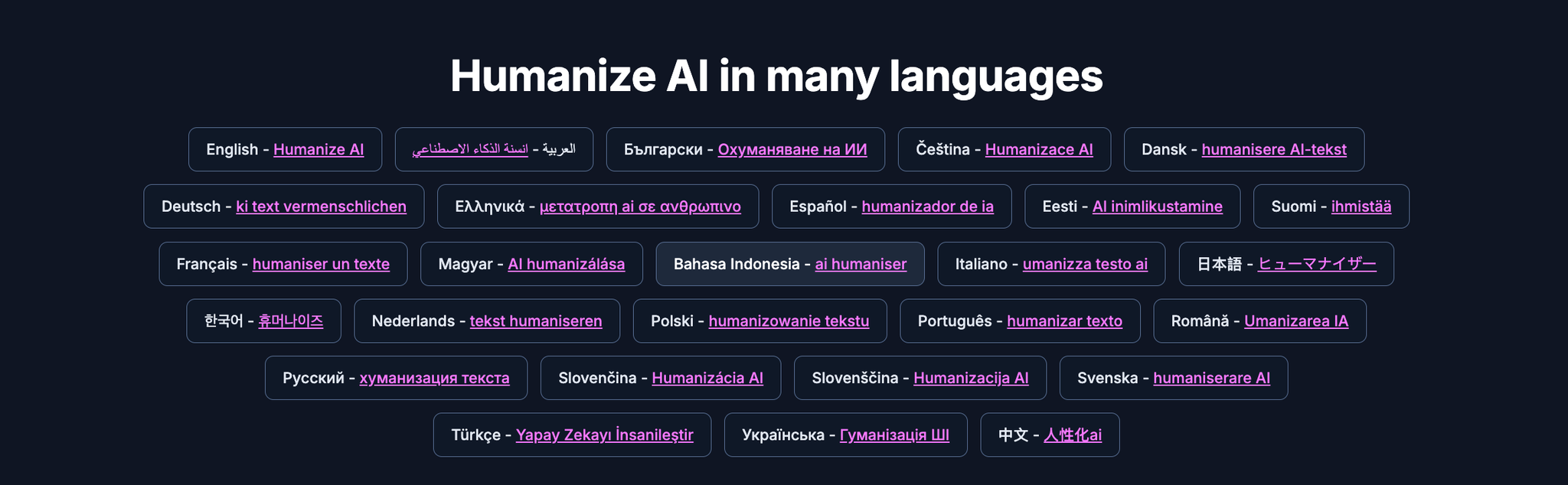
3. Multilingual Humanization
Supports 20+ languages with cultural tone adaptation. It does not rely on literal translation, which often increases detection risk.
Multilingual Humanization
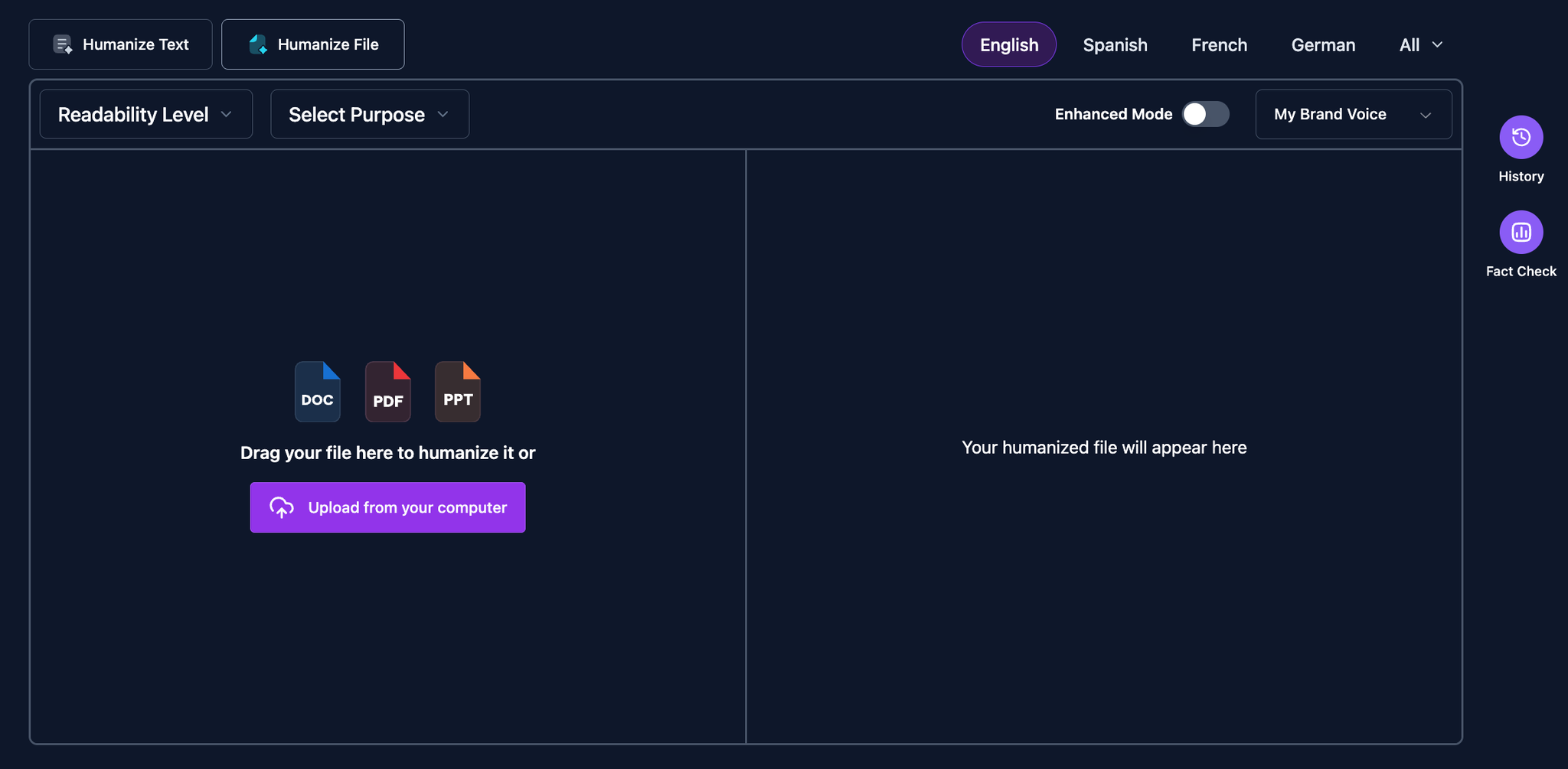
4. File Upload Support
Users can upload DOC, PDF, and TXT files. The tool rewrites full documents in one session, saving time and preserving narrative coherence.
Full-Document Upload and Editing
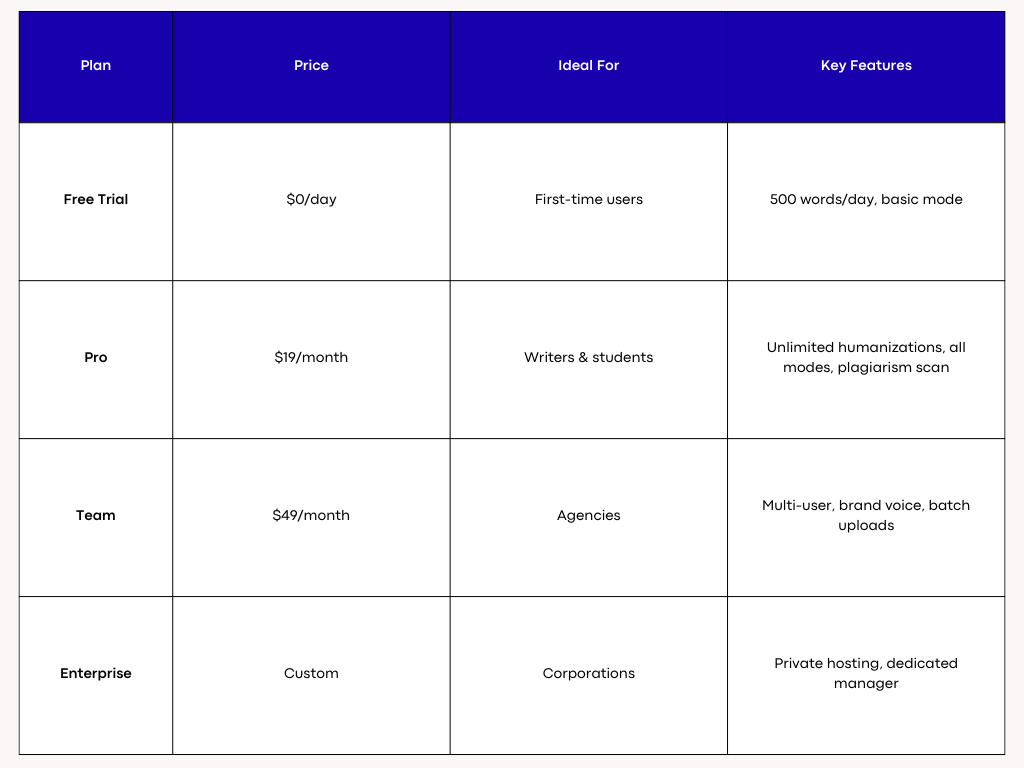
Humanize AI Pricing
Humanize AI Text Pricing

Humanize AI Text Pricing
3. GPTZero : Popular Academic AI Detector
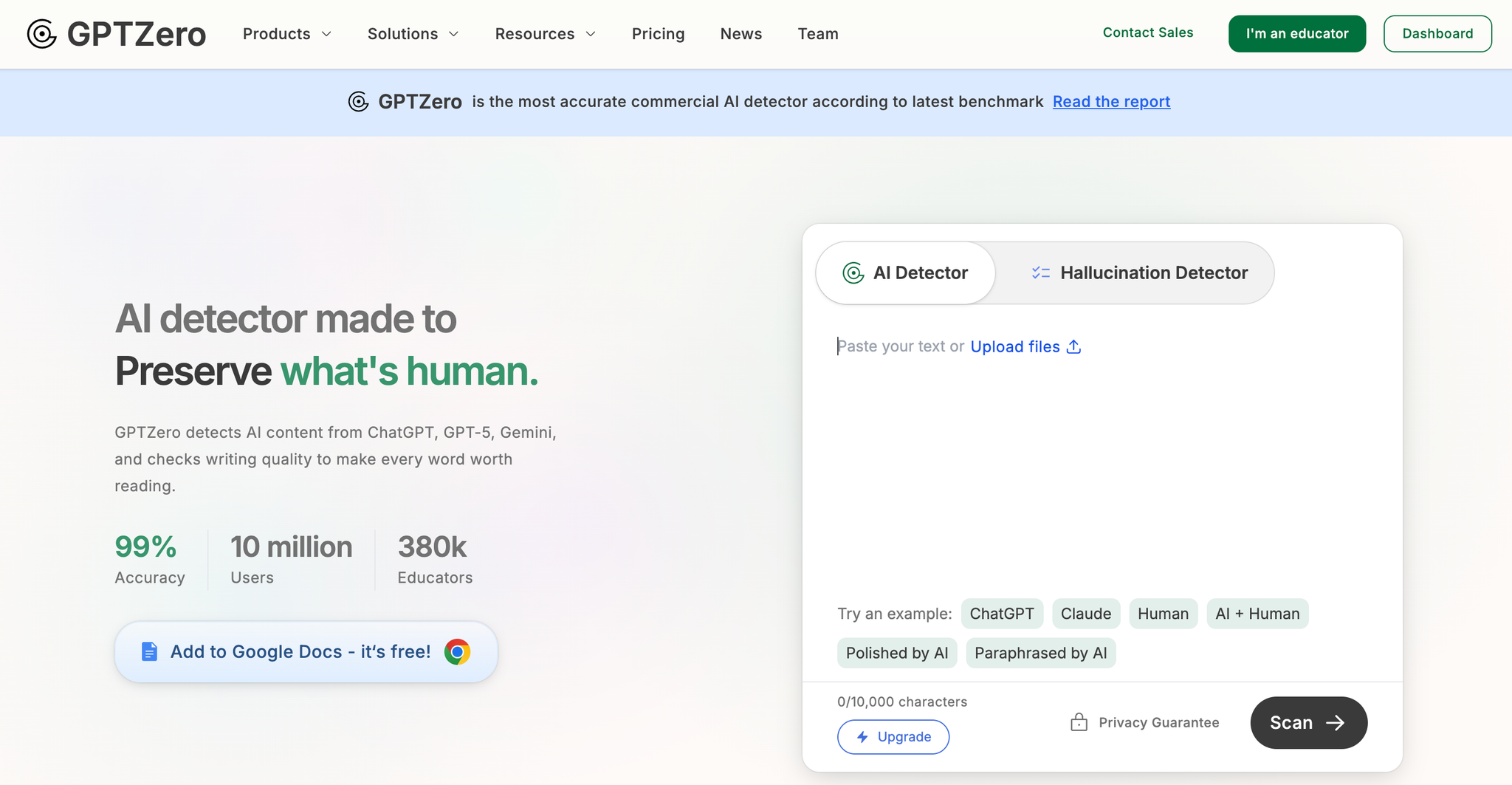
GPTZero is one of the most widely recognized AI detectors, especially in education. It focuses heavily on perplexity and burstiness metrics. Many schools adopted GPTZero early because of its simple interface and clear labels.
However, GPTZero is also known for inconsistency. Polished human writing often scores as AI, while lightly edited AI text sometimes passes. GPTZero works best as a signal, not a verdict. It is useful for trend analysis but unreliable as sole evidence.
GPTZero
Key Features of GPTZero
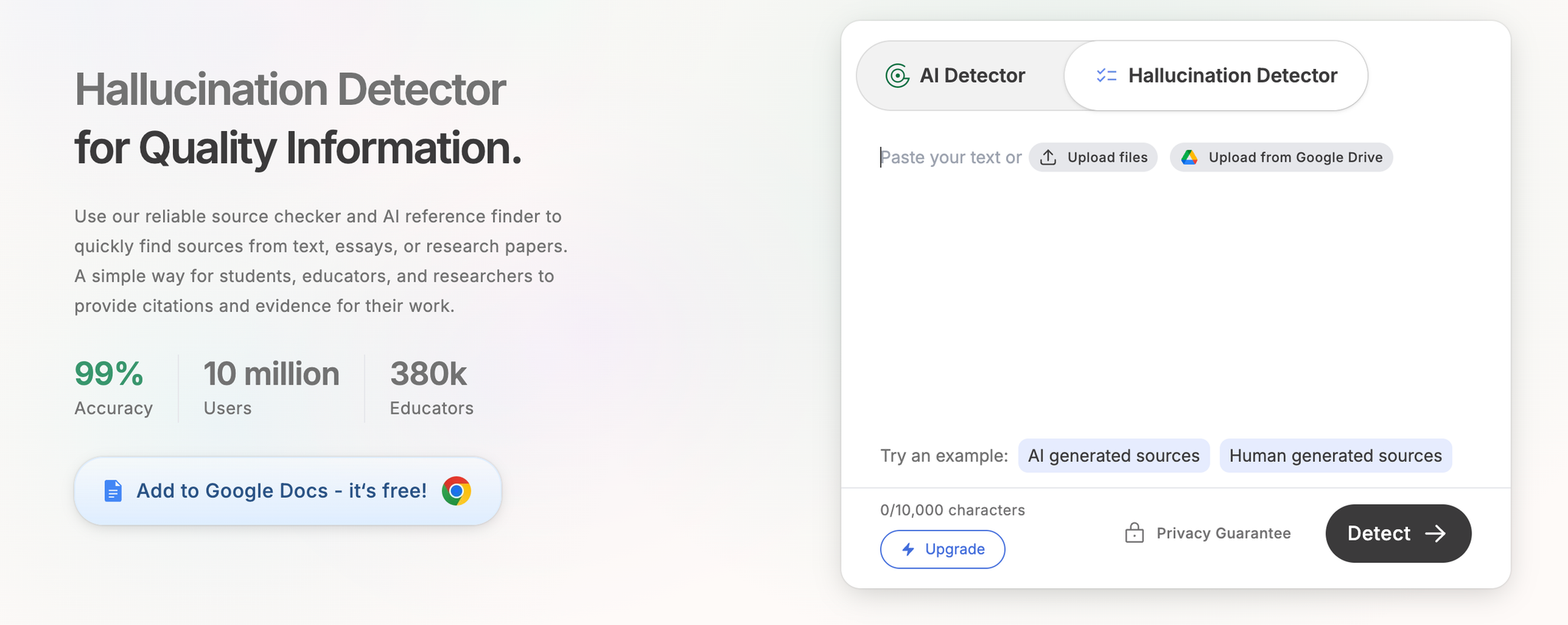
1. Hallucination Detector
GPTZero’s hallucination detector focuses on identifying patterns that suggest AI-generated text rather than factual accuracy alone. It measures predictability in word choice and sentence construction, which are common signals of language model output. When text appears overly smooth or statistically consistent, the detector raises flags. This feature is especially useful in academic settings, where instructors want to identify AI-assisted writing based on linguistic behavior, not just surface-level errors.
Hallucination Detector
2. Google Docs Extension
The Google Docs extension allows users to analyze content directly inside their document without copying and pasting text elsewhere. As writers edit, GPTZero evaluates sentence variation and rhythm in real time. This helps identify sections that appear too uniform or machine-like. For educators and students, the extension streamlines review workflows and makes AI detection part of the natural writing and editing process.

Google Docs Extension
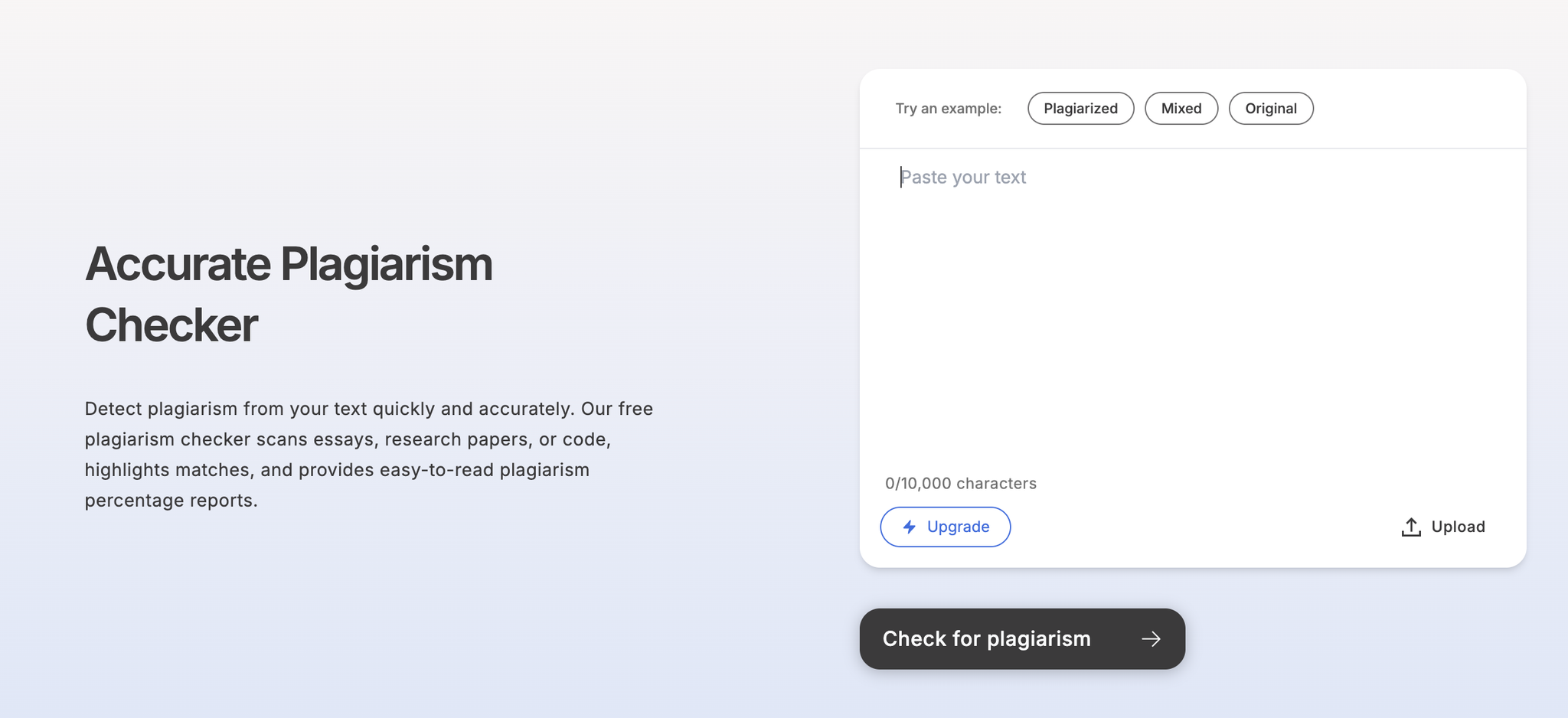
3. Plagiarism Detector
GPTZero includes a basic plagiarism detection layer that works alongside its AI analysis. It highlights specific lines or passages that may overlap with existing sources or show repetitive phrasing patterns. While not as deep as standalone plagiarism tools, this feature helps users quickly identify risky sections. Combined with AI scoring, it provides additional context when reviewing originality and content integrity.
Plagiarism Detector
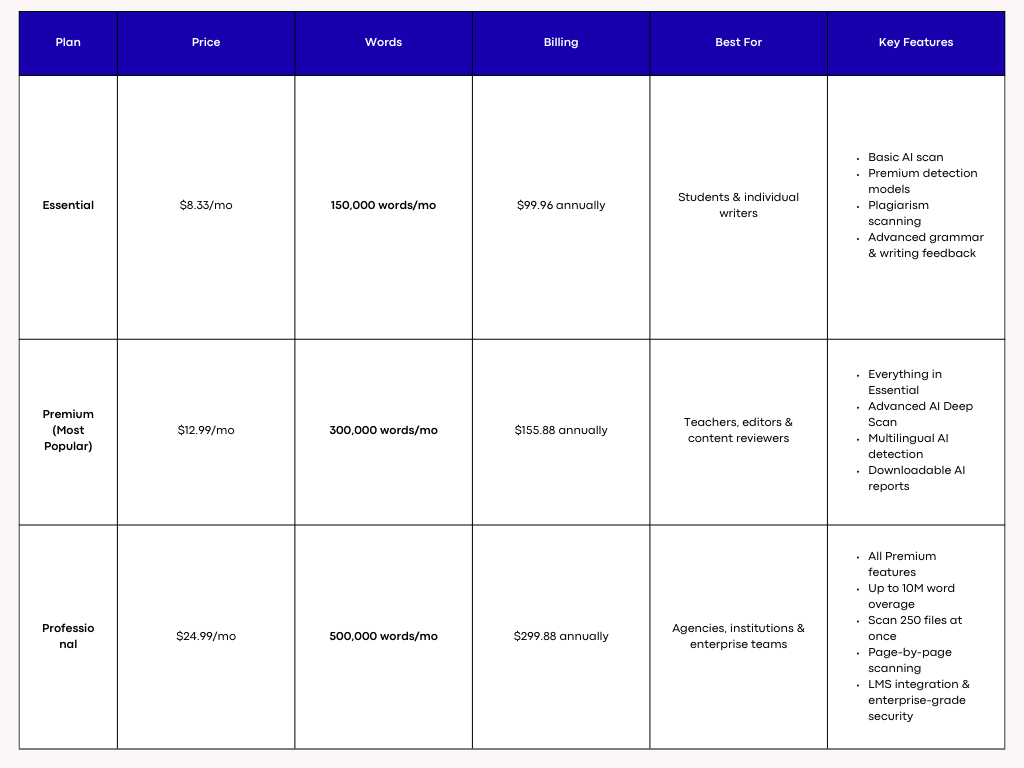
GPTZero Pricing
GPTZero — Pricing
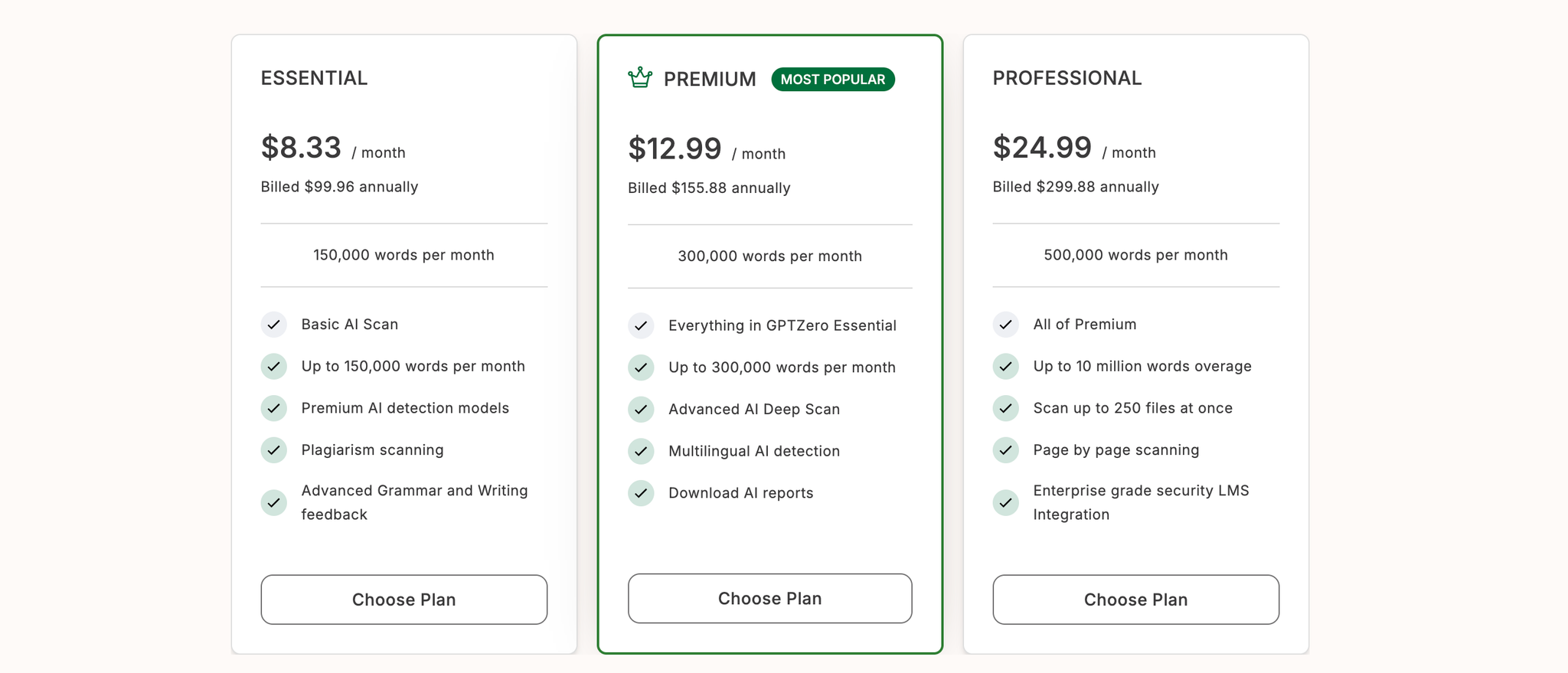
GPTZero — Pricing
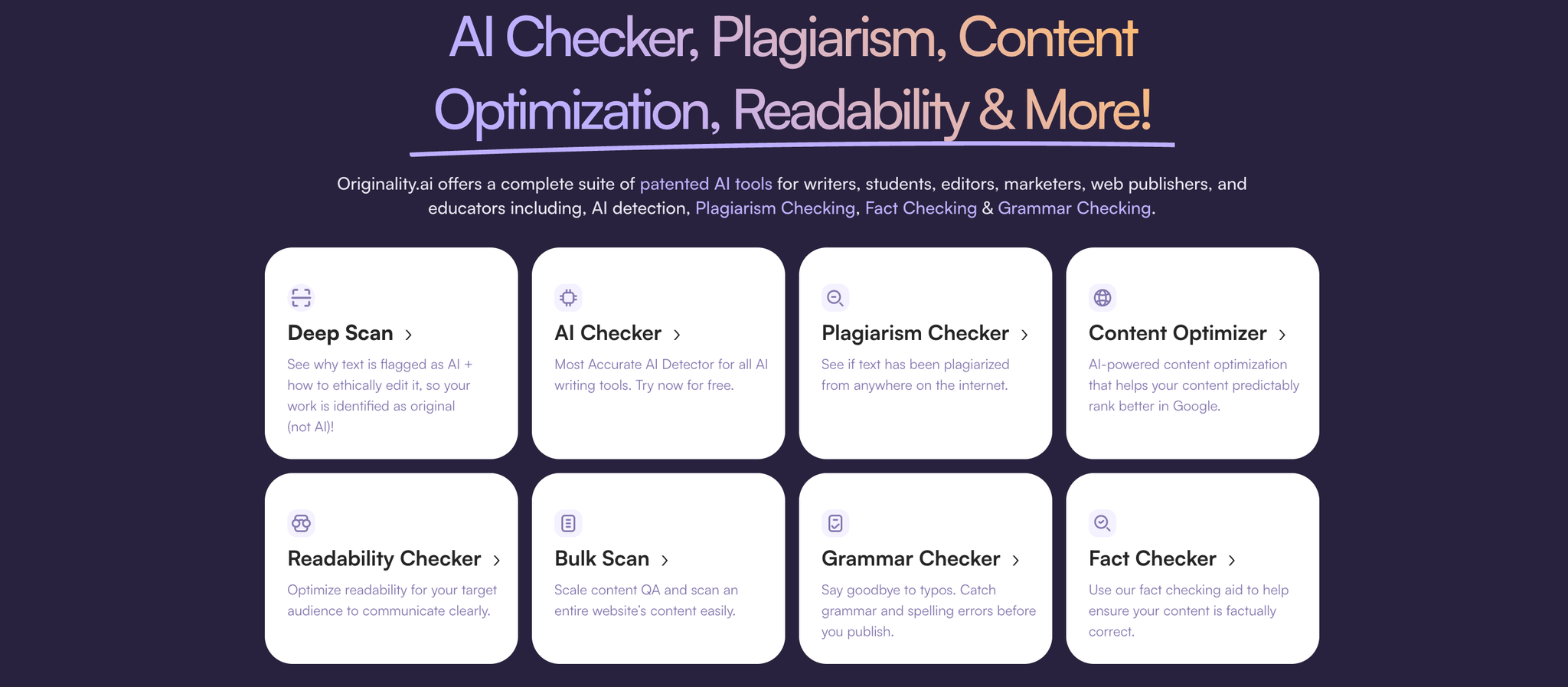
4. Originality.ai: Best for Publishers and SEO Teams at Scale
Originality.ai is best known for detecting AI-generated content and plagiarism across long-form articles and entire websites. It is widely used by SEO agencies, publishers, and content managers who need to audit content before publishing or acquiring sites. Unlike classroom-focused detectors, Originality.ai is built for scale. It scans large volumes of content quickly and assigns AI probability scores that help teams decide what needs revision.
The platform is intentionally strict, which makes it useful for risk assessment but also prone to false positives. For professional publishing workflows, Originality.ai works best as a screening tool rather than a final authority. It excels when combined with humanization tools that address flagged sections before publication.
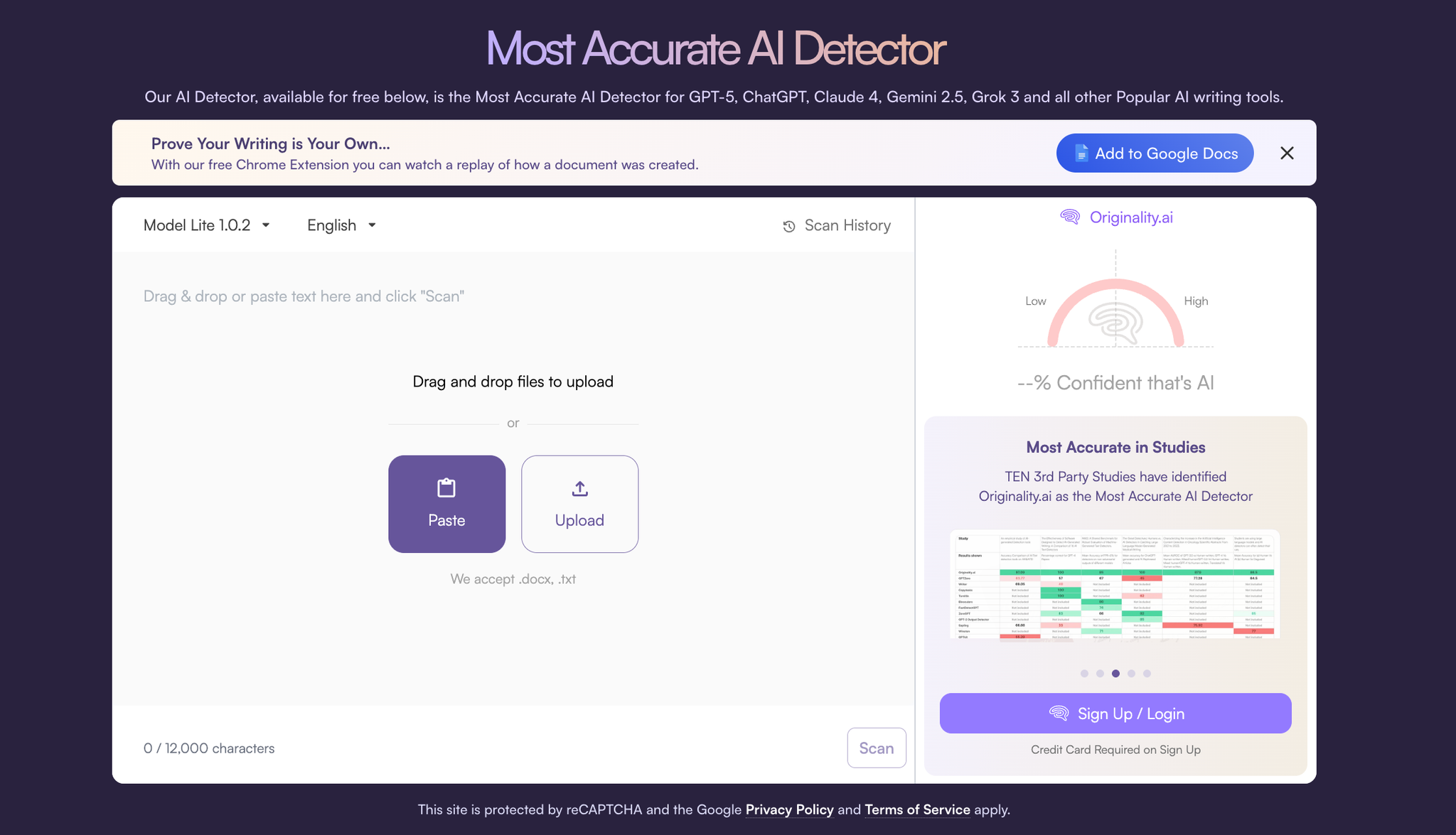
originality.ai
Key Features of Originality.ai
1. AI Content Detection
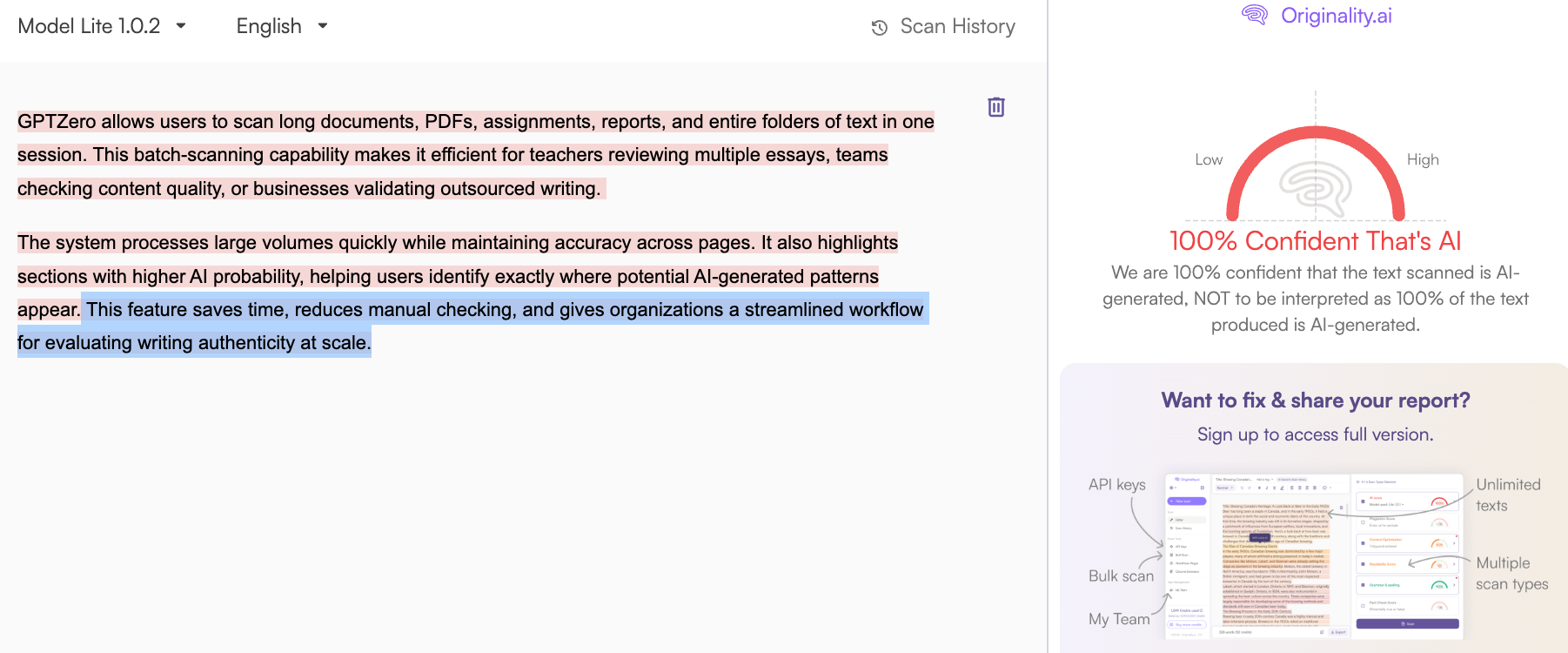
Originality.ai analyzes long-form content for AI-generated patterns using probability modeling and structural analysis. It assigns percentage-based AI likelihood scores rather than binary labels. This makes it useful for comparing drafts and spotting risky sections, especially in SEO content. However, its strict thresholds mean even polished human writing can be flagged, so results should be interpreted cautiously.
AI Content Detection
2. Plagiarism Detection
The platform includes built-in plagiarism scanning that checks text against indexed web sources. It highlights overlapping phrases and duplicated structures, allowing editors to address originality issues early. For publishers, this dual AI + plagiarism check reduces the need for multiple tools in the review process and helps maintain editorial standards.
Plagiarism Detection
Originality.ai Pricing (Quick View)
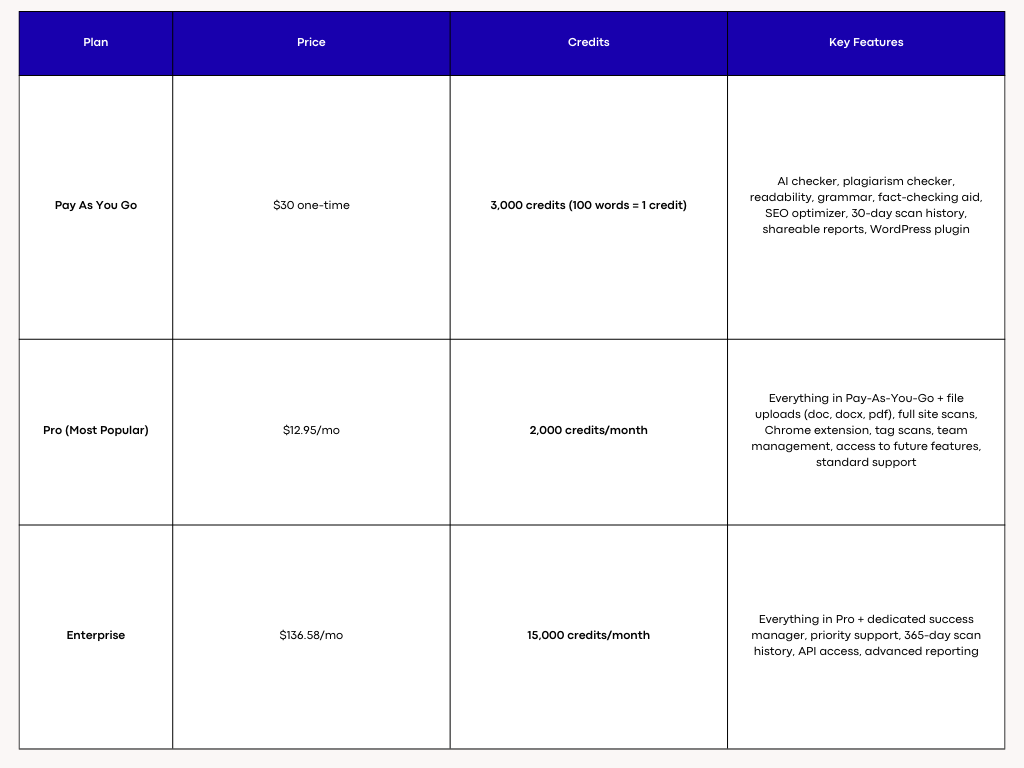
originality.ai — Pricing

originality.ai — Pricing
5. Copyleaks: Best for Academic and Enterprise Compliance
Copyleaks is an enterprise-grade platform that combines plagiarism detection with AI-generated content identification. It is commonly used by universities, corporations, and LMS platforms that require strict compliance and reporting.
Copyleaks is designed for policy enforcement rather than creative workflows. Its AI detection is conservative and often flags content that other tools pass. This makes it effective for institutional screening but less flexible for writers. Copyleaks works best in environments where consistency and documentation matter more than nuance. For content creators, it is typically used as a final compliance check rather than a drafting aid.

Copyleaks
Key Features of Copyleaks
1. AI Content Detection
Copyleaks analyzes text for AI-generated patterns using proprietary machine learning models. It focuses on consistency, predictability, and linguistic markers associated with large language models. Results are presented as likelihood scores, often with strict thresholds. This conservative approach is why Copyleaks is trusted by institutions, but it can also increase false positives for well-edited human writing.

Advanced AI Detection Models
2. Plagiarism Detection Engine
Copyleaks is widely known for its plagiarism detection capabilities. It compares content against a large database of academic and web sources. This feature is deeply integrated with its AI detection system, allowing institutions to assess both originality and authorship risk in a single scan.

Native Canvas & LMS Integration
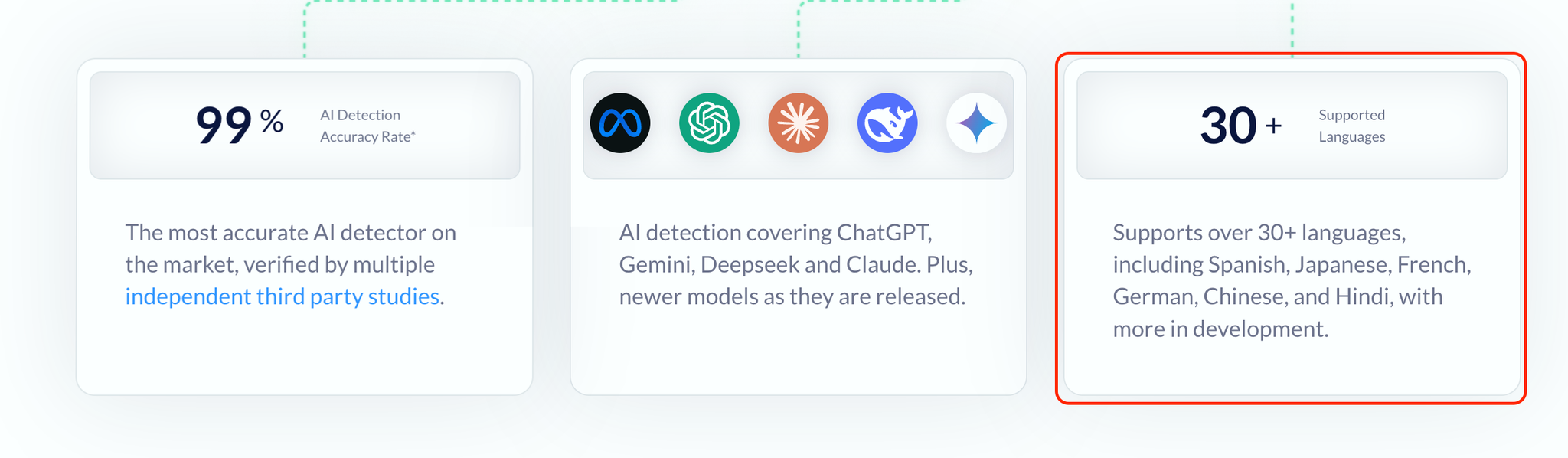
3. Multilingual Support
Copyleaks supports detection across dozens of languages. This makes it suitable for international institutions and global organizations that need consistent enforcement across regions. However, multilingual detection accuracy can vary depending on language complexity.
Multilingual Support
Copyleaks Pricing
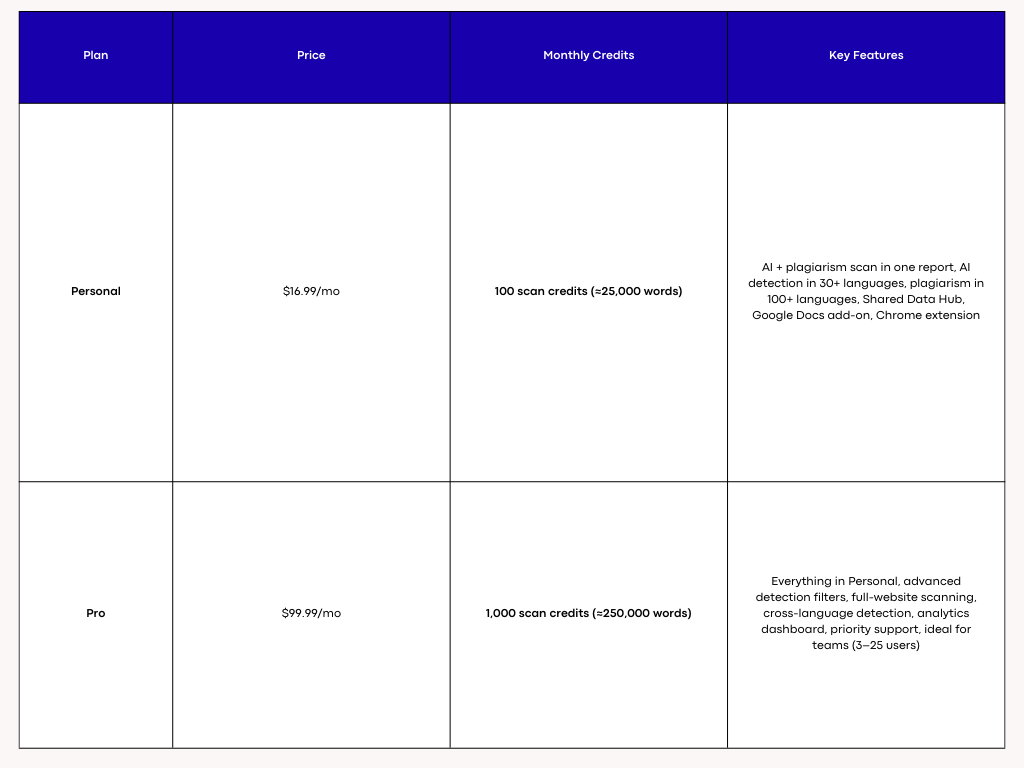
Copyleaks — Pricing

Copyleaks — Pricing
Plagiarism vs. AI Detection: Two Different Problems
One distinction that gets muddled constantly: AI detection and plagiarism detection are not the same thing, and you need different tools for each.
Plagiarism checkers compare your text against indexed databases of published content and flag direct matches. AI detectors measure statistical writing behavior. A piece of text can be completely original (no plagiarism) and still get flagged as AI-generated. It can also be partly plagiarized while passing an AI detector cleanly.
This is why using both types of tools matters. Humanize AI's plagiarism checker handles the originality side — checking whether your content matches published sources — while a separate AI detection layer handles the statistical fingerprint question. Running both before publishing is now table stakes for any serious content operation.
Can Google Detect AI Content?
This question exploded the second AI-generated SEO content became mainstream. And the answer is nuanced.
Google has repeatedly stated that it does not automatically penalize content simply because AI helped create it. What Google cares about is quality — specifically originality, usefulness, expertise, trustworthiness, and value to readers.
The problem is that low-quality AI content often exhibits patterns Google already dislikes: shallow explanations, repetitive phrasing, generic insights, low originality, templated structure.
So people confuse "Google penalizes bad content" with "Google bans AI content." Those are not the same thing.
In reality, many successful websites already use AI-assisted workflows. The difference is that strong publishers heavily edit, expand, fact-check, personalize, and restructure their drafts. AI is increasingly becoming part of the workflow. But publishing raw machine output at scale still tends to produce mediocre content — and mediocre content rarely survives long in search.
Google's own Search Quality Rater Guidelines, which evaluators use to score pages manually, place heavy weight on "Experience, Expertise, Authoritativeness, and Trust" (E-E-A-T). None of those signals are automatically disqualified by AI involvement. They are disqualified by thin, derivative content.
If you want to learn more about Google's stance, check out our blog: Does Google penalize AI content?
How Writers Reduce AI Detection Signals Ethically
Here's where the internet gets weird. A huge amount of "bypass AI detector" content sounds like it belongs in a cyberpunk crime documentary. But most real writers are not trying to hack detectors.
They are trying to avoid false positives and make AI-assisted drafts sound genuinely natural. There's a major difference.
The strongest editing strategies are actually very human:
- Restructuring ideas instead of accepting the AI's organization.
- Adding personal insight and specific examples.
- Changing pacing deliberately — short sentences after long ones.
- Varying sentence length across paragraphs.
- Introducing specificity (names, numbers, places) where AI generalized.
- Rewriting transitions to sound conversational, not formal.
- Removing repetitive scaffolding ("As mentioned above," "It's important to note").
Good editing restores cognitive texture. It makes writing feel like a person actually thought through the ideas instead of generating statistically smooth paragraphs in one pass.
Ironically, the best way to reduce AI signals is to become more human, not more deceptive. For a practical breakdown of exactly how to do this, the guide on tips for humanizing AI-generated text covers the specific techniques that move the needle most.
Why Humanization Tools Exist
Humanization tools emerged because users discovered something important very quickly: basic paraphrasing wasn't enough.
You could swap synonyms all day and detectors would still flag the underlying structure. Modern humanization systems instead focus on rhythm variation, structural unpredictability, discourse flow, sentence pacing, and conversational irregularity.
Humanize AI works on this principle — it doesn't just replace words, it reshapes the statistical behavior of the text itself. It also preserves facts, keywords, citations, and formatting while doing so, which matters enormously for SEO and academic work where changing the substance isn't an option.
That's why the humanization market grew so fast. People realized AI detection was less about individual words and more about statistical writing behavior. If you're looking at options beyond a single tool, this overview of the best AI humanization tools for content creators is worth reading before committing to a workflow.
Should You Trust AI Detectors?
Trust them carefully.
AI detectors can absolutely identify suspicious patterns. They can catch lazy AI output, flag repetitive machine structure, identify statistically smooth writing, and assist editors and educators. But they are not magical authorship machines.
They cannot read intent, prove cheating, determine who wrote something, understand the writing process, or distinguish all forms of collaboration.
At best, AI detectors are editorial signals. Useful signals. Sometimes valuable signals. But still signals.
Treating them as unquestionable truth creates obvious problems: false accusations, flawed moderation, broken trust, poor editorial decisions.
The healthiest approach is skepticism balanced with practicality. Use detectors as diagnostic tools, not courtroom judges. And when you genuinely need to know where your content stands before publishing, running it through Humanize AI's AI detector gives you a fast, reliable baseline to work from.
Because ultimately, language is messy. And humans are even messier. That messiness is exactly what machines are still struggling to imitate.
Final Thoughts
Understanding what is an AI detector requires separating perception from reality. These tools do not determine truth. They estimate probability. They measure patterns, not intent. That limitation explains why false positives are common and why no detector should ever stand alone.
The smartest approach is not fear or avoidance. It is workflow design. Tools like Humanize AI and AISEO exist because writing today must satisfy both human readers and algorithmic systems. Detection tools like GPTZero, Originality.ai, and Copyleaks offer signals, not judgments.
When content flows naturally, varies rhythm, and communicates clearly, it already aligns with human expectations. Detection scores then become secondary. The future belongs to writers and teams who understand these systems instead of blindly trusting them.
Frequently Asked Questions About AI Detectors
1. What is an AI detector and how does it work?
An AI detector is software that estimates whether text was written by a human or generated by an AI model. It works by analyzing statistical writing behavior — measuring things like word predictability (perplexity), sentence rhythm variation (burstiness), and how closely the text mirrors known AI output patterns. It does not compare your writing to a database of sources like a plagiarism checker does.
2. Can AI detectors give false positives?
Yes — frequently. Human writing gets flagged as AI regularly, especially SEO content, heavily edited drafts, academic writing by non-native English speakers, and any text that has been run through grammar tools like Grammarly. A 2023 Stanford study found non-native speakers were falsely flagged at disproportionately high rates. No detector is accurate enough to be treated as definitive proof of authorship.
3. Is AI-generated content penalized by Google?
Not automatically. Google's stated position is that it evaluates content on quality, usefulness, and trustworthiness — not on whether AI was involved in creating it. The problem is that most raw, unedited AI content is low-quality by these standards. Publishers who edit, fact-check, and add genuine expertise to AI drafts generally see no penalty.
4. Can AI detectors detect edited AI content?
Sometimes, but not always. Light editing—such as changing a few words or running text through a basic paraphraser—often fails to remove the underlying statistical patterns that detectors analyze. In these cases, detectors can still flag the content as AI-generated.
Deeper editing is more effective. When text is restructured to change sentence rhythm, vary paragraph flow, and introduce natural inconsistencies, detection risk drops significantly. This is because detectors are not looking for “AI ideas.” They are looking for predictable patterns. When those patterns are broken through thoughtful rewriting, detectors struggle to classify the text accurately.
5. Does grammar correction increase AI detection risk?
Yes, it often does. Grammar correction tools and aggressive editing can unintentionally increase AI detection risk. These tools tend to smooth language, remove irregular phrasing, and standardize sentence structure. While this improves readability, it also reduces the natural variation that human writing usually contains.
AI-generated text is typically very clean and consistent. When human writing is polished to the same level, detectors may interpret it as machine-generated. This is one of the reasons many false positives occur. Clear writing is not the problem. Over-uniform writing is. Allowing some natural variation in sentence length and phrasing helps preserve a human statistical profile.
6. Is it possible to get 0% AI detection?
No. There is no guaranteed way to achieve a 0% AI score across all detectors. Even entirely human-written content can be flagged. Detection tools work on probability, not certainty. They will always produce some level of risk score.
The realistic goal is risk reduction, not perfection. Professionals aim to lower scores enough that content reads naturally, passes human review, and does not trigger unnecessary scrutiny. Chasing a perfect score often leads to over-editing, which can ironically make detection worse. Accepting that some uncertainty will always exist is part of working with AI detectors responsibly.
7. Are AI detectors used by Google?
There is no evidence that Google uses public AI detectors as part of its ranking systems. Google has been clear that it focuses on content quality, usefulness, and relevance—not on whether content was written by AI or humans. Google’s concern is whether content helps users, not how it was produced.
Public AI detectors are designed for education, publishing, and compliance—not search ranking. Relying on detector scores to guide SEO decisions is misguided. What matters for Google is originality, clarity, accuracy, and value. Content that meets those standards performs well regardless of how it was created.
8. Do AI detectors work on multilingual text?
AI detectors generally perform worse on multilingual content. Most detectors are trained primarily on English-language data. When analyzing other languages, accuracy drops and false positives increase. Sentence structure, idiomatic expressions, and linguistic rhythm vary widely across languages, making reliable detection more difficult.
In multilingual contexts, detector scores should be treated with even more caution. A high AI score in a non-English language often reflects model limitations rather than actual AI usage. For global content teams, human review and contextual judgment are far more reliable than automated detection results.
9. Can AI detectors replace human editors?
No. AI detectors cannot replace human editors, reviewers, or instructors. They analyze statistical patterns, not meaning. They cannot assess nuance, intent, creativity, or factual accuracy. They also cannot understand context, tone, or purpose.
Human editors evaluate whether writing makes sense, serves its audience, and communicates effectively. Detectors only estimate how closely text matches AI-generated patterns. Used together, detectors can assist human reviewers by highlighting areas to examine more closely. Used alone, they are insufficient and often misleading.
10. Should writers fear AI detectors?
No. Writers should not fear AI detectors, but they should understand them. Fear leads to overcorrection, unnatural writing, and unnecessary stress. Knowledge leads to smarter workflows and better content.The most effective approach is to focus on clarity, authenticity, and human readability. When writing flows naturally and communicates clearly, it already aligns with what real readers expect. Detector scores then become secondary. AI detectors are tools, not judges. Writers who treat them as signals—rather than threats—are far better positioned to succeed in modern content environments.
11. What's the difference between an AI detector and a plagiarism checker?
An AI detector measures statistical writing behavior to estimate whether AI generated the text. A plagiarism checker compares your content against published sources to find copied passages. They solve different problems. A piece of writing can be completely original (no plagiarism) and still trigger an AI detector — or vice versa. Using both tools separately, like Humanize AI's plagiarism checker alongside its AI detector, gives you a complete picture before publishing.
12. Why do different AI detectors give different results?
Because they use different scoring systems, training datasets, and detection thresholds. There's no universal standard for what counts as "AI writing." Each platform interprets the same statistical signals differently, which is why the same text can score 95% AI on one tool and "Mostly Human" on another. This is one of the core reasons AI detection results should never be used as standalone evidence.
14. Are AI detectors fair to all writers?
No — and this is a serious problem. Research has shown that non-native English writers, people who use formal academic register, and anyone who writes in a highly consistent or structured style face significantly higher false positive rates. AI detectors were largely trained on native-English, conversational writing patterns, which creates a built-in bias against writers who don't fit that profile.
About the Author

Dilyar Buzan is the founder and CEO of AISEO.ai, an AI-native SEO platform. With a background in AI from the University of Amsterdam, Dilyar specializes in Generative Engine Optimization (GEO), Answer Engine Optimization (AEO), and AI-driven content strategy, helping brands earn visibility across ChatGPT, Perplexity, Google AI Overviews, and traditional search. He's also co-founder of Sceneform.ai, an AI content platform for brands and creators.