
Most bloggers already use AI in some capacity now. According to HubSpot, around 94% of marketers plan to use AI in their content creation workflows in 2026. Meanwhile, Ahrefs found that 74.2% of newly published webpages already contain AI-generated content in some form.
Ironically, the biggest bottleneck today is no longer generating content. It’s cleaning up the weird robotic sludge that AI tools leave behind afterward.
So the question is no longer: “Should bloggers use AI?”. The real question is: “How do you use AI without your content sounding like a customer support chatbot trying to become a thought leader on LinkedIn?”
After testing a ridiculous number of GPTs, AI editors, formatting tools, and humanizers, this is the AI stack I’d actually use if I wanted to run a blog efficiently while still sounding like a real person with functioning brain cells.
Why Most "Best AI Tools for Bloggers" Lists are Wrong
Every article on this topic does the same thing: it lists twelve AI platforms, describes what each one claims to do, and leaves you with zero guidance on when to use any of them. That is not a workflow. That is a product directory with affiliate links.
The actual problem bloggers face in 2026 is not a shortage of AI tools. It is friction: specific, predictable friction points that appear at the same stages in every blogging workflow. Raw drafts that sound robotic. Formatting that breaks inside WordPress. AI-generated text that buries a detector flag right before you publish. Repurposing that never happens because it takes too long to do manually.

best-AI-stack-for-bloggers
A single all-in-one AI platform cannot fix friction at every stage. They are built to be convenient, not excellent. The best AI stack for bloggers solves each bottleneck with the right specialized tool… and that is exactly what this guide maps out.
If you want to understand what an AI detector is and why it matters more than most bloggers realize, that is worth reading separately. But the short version is this: detectors flag predictable phrasing patterns, and most raw AI output is full of them. Fixing that problem requires a dedicated humanization step, not hoping your all-in-one platform handles it.
How I Built This Stack
I did not build this stack by reading product pages. I built it by running into the same problems repeatedly and testing whatever solved them fastest.
The friction points I kept hitting were consistent regardless of which base AI model I used. ChatGPT, Claude, Gemini, it did not matter. Every raw draft had some combination of mechanical rhythm, invisible formatting characters, structural weakness in the middle sections, and transitions that felt like a content brief stapled to a list. That was the real workflow problem.
The stack below covers seven stages. Each stage has at least one primary tool and, where the problem is complex enough, a backup. You do not need all of these on every post, but knowing which tool to reach for at each stage is the entire point.
One caveat before we go further: this stack assumes you are editing. If you are looking for a system that writes and publishes with zero human review, this is not it. These tools accelerate a writer's workflow. They do not replace editorial judgment, topical expertise, or the specific perspective that makes a blog worth reading.

best-AI-stack-for-bloggers-drafting-tools
Stage 1: Drafting: Build the Skeleton Before You Write a Word
The best use of AI in the drafting stage is structure, not sentences. A tool that generates a complete, logical outline for a 3,000-word post in 30 seconds saves more time than any sentence-level writing assistant. Get the architecture right first, then fill it in.
Article Generator
Article Generator from HumanizeAIText.ai is the tool I'd start with for most blog posts. Feed it your target keyword and a quick intent signal, and it produces a structured draft with logical section progression.
The output is not ready to publish (it never is), but it gives you a working rough draft that is genuinely faster to edit than starting from a blank document.
The honest limitation: it will occasionally flatten nuanced topics into generic coverage. Your job is to add the specificity, the examples, the opinions. Treat the output as scaffolding, not finished work.
Essay Generator
Essay Generator handles a slightly different problem: long-form structural planning. For pillar pages, comprehensive guides, or any post where you need to sequence 8–12 subtopics without burying the most important content at the bottom, this tool is useful before you write a single sentence.
It helps you organize ideas logically and catch structural gaps early… before those gaps cost you 45 minutes of reorganizing mid-draft.
AI Sentence Generator
AI Sentence Generator is a much narrower tool and more useful for it. It solves one specific problem: momentum stalling. You know what you want to say but cannot find the opening line, or you've written yourself into a transition that goes nowhere.
This tool generates strong opening sentences, topic sentences, and transitions on demand. It is not for generating paragraphs, but for unlocking the sentence that lets you keep moving.
best-AI-stack-for-bloggers-humanizing-tools
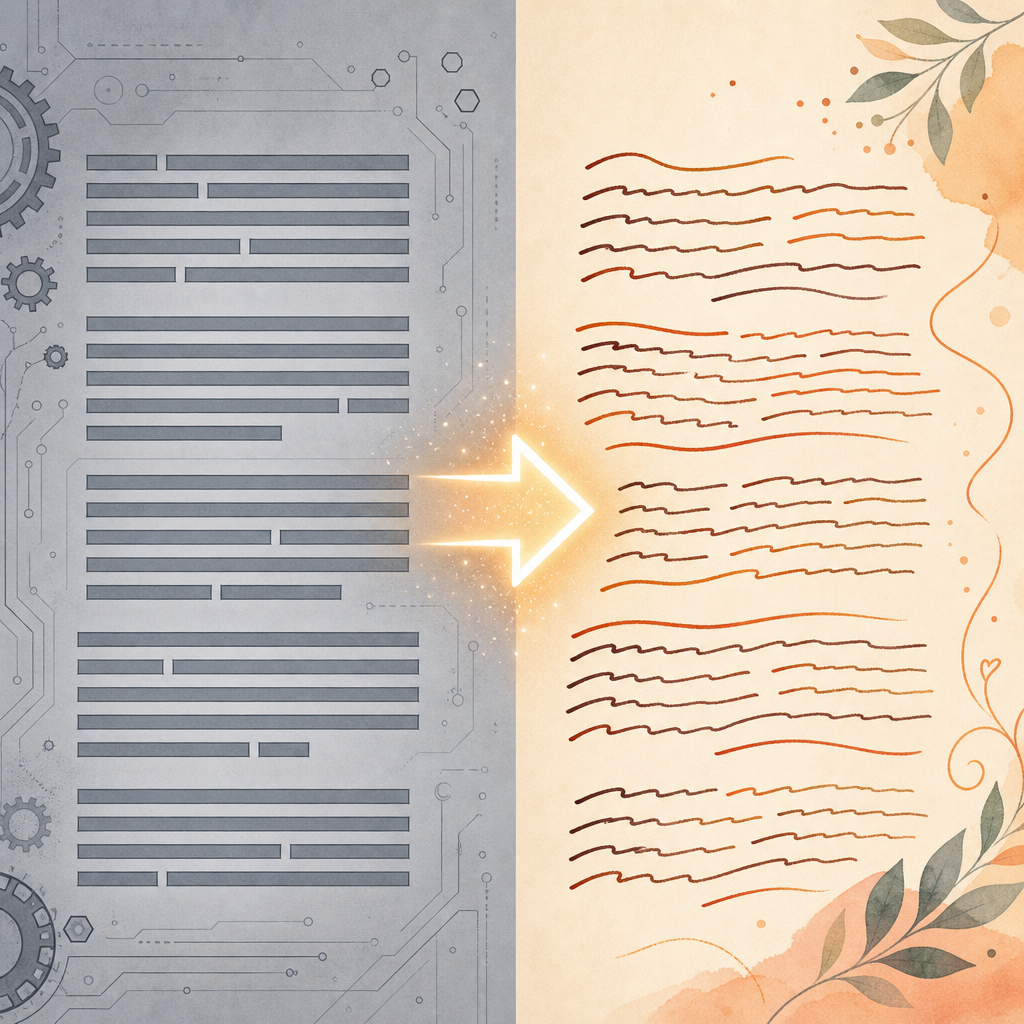
Stage 2: Humanizing: The Part Most Bloggers Skip Entirely
This is the highest-leverage stage in the entire workflow, and it is also the one most bloggers either skip or do badly. Publishing a raw AI draft without a humanization pass is how you end up with content that is technically correct and completely unreadable.
Raw AI drafts tend to fail in five consistent ways:
- Repetitive sentence rhythm (every sentence roughly the same length and structure)
- Transitions that feel like they were written by someone who learned English from a corporate memo
- Over-polished phrasing that sounds confident without saying anything specific
- Emotional flatness throughout
- An inability to take a clear stance on anything.
Readers feel all of this even when they cannot name it.
Adding The “Human” Vibe In AI-Generated Text
HumanizeAIText.ai is the primary tool at this stage. It improves sentence rhythm, introduces variation, and smooths transitions without changing your original meaning. What makes it useful… and this is worth understanding… is that it focuses on readability, not on gaming AI detectors.
A paragraph can pass every major detector while still reading like a customer service chatbot. This tool targets the actual problem, which is that readers disengage from mechanical writing regardless of what any detection score says.
My HumanizeAIText.ai review breaks down how the tool works and what it actually improves. It is worth reading if you want to understand why readability-focused humanization produces better long-term results than detector-score optimization.
Rewrite AI
Rewrite AI handles structural weakness. If a section has the right information but is organized poorly, reads too densely, or lacks logical flow between ideas, Rewrite AI restructures it at the paragraph level.
I find it most useful for two situations: paragraphs that are technically correct but confusing, and older blog posts that need refreshing. Instead of rewriting those sections manually, you can run them through Rewrite AI and get a structurally improved version to edit from.
Rewording Tool
The Rewording Tool is more surgical. It improves individual sentences without touching the surrounding structure. When a sentence is technically fine but awkward, overcomplicated, or slightly off-tone, this is faster than rewriting it manually.
It also helps align sentence-level phrasing to search intent, particularly useful when you realize a key paragraph is not quite answering the question a user would actually have.

best-AI-stack-for-bloggers-quality-checking-tools
Stage 3: Quality Checks: Two Problems Most Bloggers Think Are One
Before you publish, you need to run two separate checks that solve two completely different problems. Most bloggers conflate them, which means they are usually solving the wrong one.
AI detection and plagiarism are not the same thing. An AI detector flags mechanical phrasing patterns. A plagiarism checker flags text similarity to existing published content. Both matter. Neither catches what the other catches. Running only one gives you a false sense of security.
AI Detector
AI Detector from HumanizeAIText.ai tells you where your content has clusters of predictable, mechanical phrasing that will register as AI-generated to both automated systems and attentive readers. Use it after your humanization check, not before.
If you run it on a raw draft, you are diagnosing a problem you are about to fix anyway (and that’s wasteful if you ask me). Run it on the humanized version and focus on any sections that still score poorly.
The important context here: Google does not penalize AI-generated content simply for being AI-generated. What Google targets is low-quality, unhelpful content.
A high AI detection score does not automatically mean a Google penalty. But it usually does mean your writing sounds robotic, and that hurts user engagement, which hurts rankings indirectly. Use the detector as a readability diagnostic, not a compliance checkbox.
Plagiarism Checker
Plagiarism Checker solves a different problem that AI introduces in a way that surprises most bloggers.
AI models are trained on enormous amounts of existing web content. When you ask them to explain a well-documented topic, they will sometimes produce text that is structurally very close to existing pages without reproducing any single sentence verbatim.
A plagiarism checker catches this before it becomes a problem.
Google's guidance on original content is explicit: pages that do not offer meaningful information gain over existing content will struggle to rank regardless of their technical quality. Catching near-duplicates before publishing keeps your content genuinely original.
best-AI-stack-for-bloggers-formatting-cleanup-tools
Stage 4: Formatting Cleanup: The Invisible Bottleneck
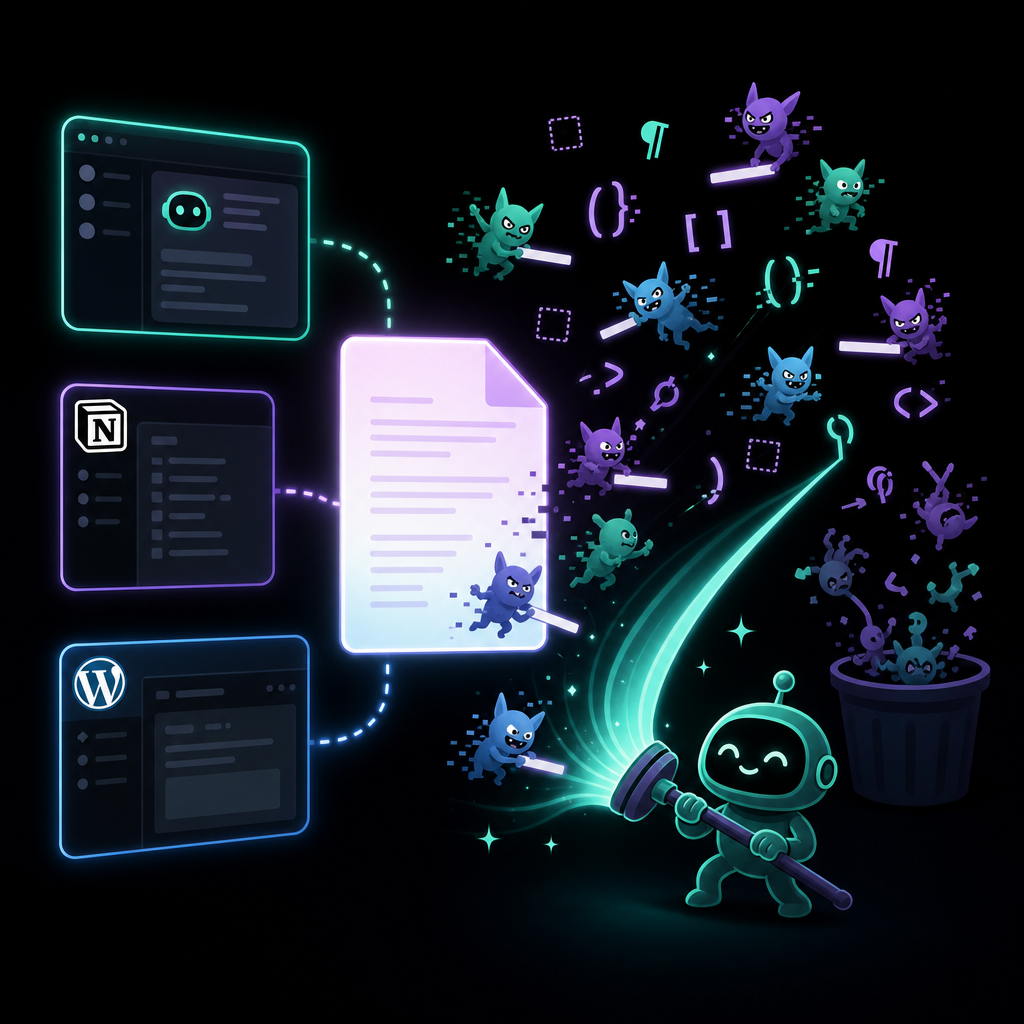
This stage is unglamorous and most bloggers underestimate how much time it saves. When you copy content between AI tools, Google Docs, Notion, and your CMS, invisible formatting artifacts travel with the text.
Zero-width spaces, non-standard encoding characters, inconsistent spacing around headings, broken bullet list syntax, em dashes that paste as something else in WordPress are problems that are invisible in your editor and visible the moment a reader lands on your page.
Text Cleaner
Text Cleaner standardizes formatting: removes extra spaces, normalizes punctuation, fixes inconsistent list structure. It is fast and takes one pass. Run it before you paste anything into your CMS and you eliminate most of the formatting troubleshooting that would otherwise happen after publishing.
Chat Watermark Remover
Chat Watermark Remover solves the more invisible problem: zero-width characters and encoding artifacts left behind by AI tools. These are characters that do not display in a text editor but cause layout breaks, heading rendering issues, and search indexing problems inside a live CMS.
They are the reason a heading sometimes renders incorrectly in WordPress even though the text looks completely normal in Docs. Run this on any draft that passed through multiple AI tools before it reached your editor.
Em Dash Remover
AI models became bizarrely obsessed with em dashes over the last two years. Almost every raw AI draft tends to overuse them as a shortcut for rhythm, transitions, and dramatic pauses. Once you notice it, you cannot unsee it.
Em Dash Remover cleans those up automatically by replacing unnecessary em dashes with more natural punctuation and sentence structure. It is especially useful for blog posts that went through multiple rewriting passes, because that is usually where the punctuation overload starts mutating into full cyberpunk poetry.
best-AI-stack-for-bloggers-variation-and-orginality-tools
Stage 5: Variation and Originality: Strengthen the Voice Before It Goes Live
This stage is not about gaming detectors. It is about making sure your final draft does not read like it was written by the same system on a different Tuesday.
AI models have stylistic fingerprints, which simply means patterns of sentence construction and phrasing that appear predictably across outputs. The tools at this stage break those patterns and introduce genuine variation.
Bypass AI Detection
Despite the name, Bypass AI Detection is most useful as a sentence variation tool. It refines phrasing so your writing does not follow predictable structural patterns.
For example, it can help generate shorter sentences where the AI defaulted to long ones, active constructions where it chose passive, concrete phrasing where it chose abstract. The practical result is writing that feels more like a person made specific choices rather than a model generating plausible text.
Paraphrase Generator
Paraphrase Generator has two legitimate uses at this stage.
First: refreshing repetitive sections. If you notice the same idea surfacing in two different parts of a post, this tool produces an alternative phrasing quickly.
Second: A/B testing. If you are split-testing headlines or intro paragraphs, Paraphrase Generator gives you genuine alternatives rather than slight synonym swaps.

best-AI-stack-for-bloggers-repurposing-tools
Stage 6: Repurposing: One Post, Multiple Distribution Channels
Most bloggers publish a post and move on. That is leaving significant distribution value unused.
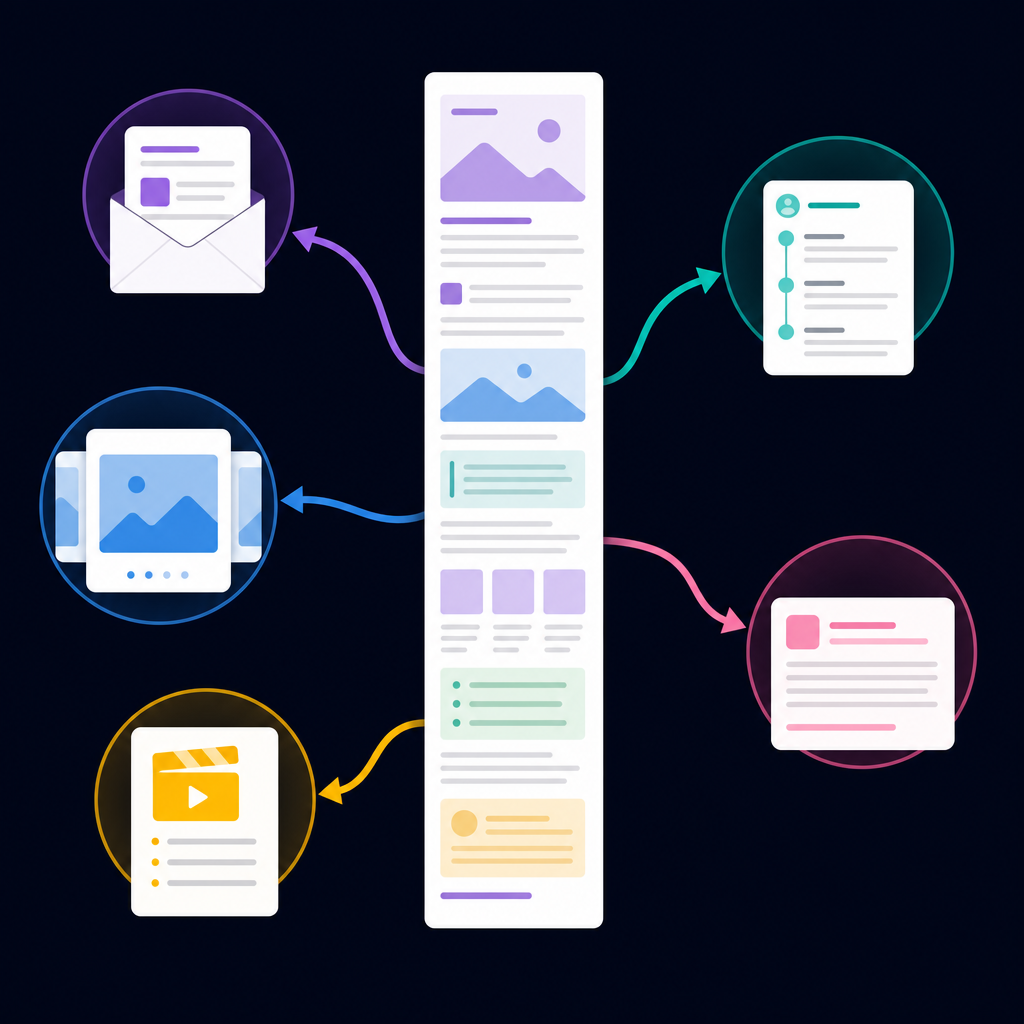
A single well-researched 3,000-word post contains enough material for a LinkedIn carousel, an email newsletter, a short-form video script, a Twitter/X thread, and at least two standalone short-form summaries.
Repurposing all of that manually takes 2–3 hours. With the right tool, it takes 20 minutes.
AI Text Converter
AI Text Converter transforms long-form blog content into platform-specific formats on demand. Give it your post, specify the output format, and it handles the structural conversion.
I use it a lot for condensing a 3,000-word guide into a 200-word email newsletter summary, extracting the five most quotable claims for social posts, or restructuring a how-to section as a video script.
The output still needs editing. Email newsletters especially need a human pass to feel personal rather than automated. But the structural labor, such as deciding what to include, what to cut, how to sequence for a different format, is done.
The Content Marketing Institute's research on content repurposing consistently shows that distribution strategy drives as much traffic growth as publishing new content. This tool makes that strategy executable instead of aspirational.
Stage 7: Outreach: Close the Loop on Link Building
Backlink outreach is one of the most consistently neglected parts of most bloggers' workflows, and the reason is almost always the same: writing personalized outreach emails at scale is tedious. So it does not happen, or it happens rarely, or it happens with templated emails that get ignored.
AI Letter Generator
AI Letter Generator produces structured outreach drafts for guest post pitches, backlink requests, collaboration proposals, and sponsorship emails. It handles the structure and the professional framing. Your job is to personalize by adding the specific reason you reached out to that person, reference something relevant on their site, and make the ask concrete.
One honest caveat: AI-generated outreach emails that are not personalized get ignored at the same rate as any other template. This tool eliminates the blank-page problem, not the personalization requirement.
Stage 8: AI Search Tracking: See Whether ChatGPT Can Find Your Blog
Once your post is live, the stack needs a feedback loop. Traditional rank trackers tell you where you appear in Google, but bloggers also need to know whether AI assistants can identify their content when readers ask for recommendations, comparisons, or how-to guidance.
Add the Chat Rank Tracker GPT to your post-publish routine. Use it to test your main keyword, a question-based version of that keyword, and a branded query. If ChatGPT names competitors but not your article, that is a signal to improve topical depth, add clearer expert commentary, refresh weak sections, and build stronger internal links into the post.
This is especially useful for bloggers because AI visibility rewards clarity and specificity. The more your article makes its unique angle, entity signals, and answer structure obvious, the easier it is for both search engines and AI systems to understand why your page deserves to be referenced.
The Full AI Stack for Bloggers at a Glance
| Workflow stage | Primary tool | What it actually solves | Link |
|---|---|---|---|
| Drafting | Article Generator | Full draft scaffold from keyword + intent | https://humanizeaitext.ai/article-generator |
| Drafting | Essay Generator | Long-form structure and section sequencing | https://chatgpt.com/g/g-D3mpJovBB-essay-generator |
| Drafting | AI Sentence Generator | Intro paralysis, transitions, momentum | https://chatgpt.com/g/g-ZNyLnMdzR-ai-sentence-generator |
| Humanizing | Humanize AI | Tone, rhythm, conversational flow | https://humanizeaitext.ai/ |
| Humanizing | Rewrite AI | Structural weakness, paragraph-level rebuild | https://chatgpt.com/g/g-0mGjweccc-rewrite-ai |
| Humanizing | Rewording Tool | Sentence-level clarity and intent alignment | https://chatgpt.com/g/g-H5Vvb4TpV-rewording-tool |
| Quality checks | AI Detector | Mechanical phrasing clusters, readability audit | https://humanizeaitext.ai/ai-detector |
| Quality checks | Plagiarism Checker | Near-duplicate content detection | https://humanizeaitext.ai/plagiarism-checker |
| Formatting | Text Cleaner | Spacing, punctuation, structural consistency | https://chatgpt.com/g/g-69779cbac5dc8191bdb3b0b63ee636eb-text-cleaner |
| Formatting | Chat Watermark Remover | Zero-width characters, encoding artifacts | https://chatgpt.com/g/g-6978fe0a4034819183bb25f4224ec106-chat-watermark-remover |
| Variation | Bypass AI Detection | Sentence variation, natural phrasing | https://chatgpt.com/g/g-696facf2a3008191b2885e6b8081ea68-bypass-ai-detection |
| Variation | Paraphrase Generator | Repetition fix, A/B testing, refreshes | https://chatgpt.com/g/g-vO6dMijKo-paraphrase-generator |
| Repurposing | AI Text Converter | One post → email, social, script, summary | https://chatgpt.com/g/g-697a4370e4208191aa79ffe83a257b51-ai-text-converter |
| Outreach | AI Letter Generator | Guest posts, backlinks, collaboration emails | https://chatgpt.com/g/g-Y6xbVSolY-ai-letter-generator |
| AI search tracking | Chat Rank Tracker GPT | ChatGPT visibility checks after publishing | https://chatgpt.com/g/g-6a37dafbed2c81919e3202a7b0d675b6-chat-rank-tracker |
What This Stack Will Not Do for You
It is worth being specific about the limits, because no AI tool roundup is honest if it skips this part.
This stack will not give you topical authority. Authority comes from publishing consistently useful, accurate content on a topic over time. No tool accelerates that; only publishing does.
If you use this stack to produce generic content faster, you will publish generic content faster. The tools improve execution. They do not improve judgment about what is worth publishing.
This stack will not fix weak E-E-A-T signals. Google's emphasis on Experience, Expertise, Authoritativeness, and Trustworthiness is about the signals behind the content: author credentials, cited sources, first-hand examples, demonstrable experience. AI tools cannot manufacture those. They can help you write more clearly about your genuine experience, but they cannot substitute for it.
And this stack will not make the bloggers who are failing with AI successful. The failure mode I see most often is not using the wrong tools. It is usually skipping the editing step entirely.
Bloggers who publish raw AI drafts with no humanization pass, no quality checks, and no personalization are producing content that readers leave within 30 seconds. No stack fixes that if the editing step is missing.
The bloggers winning with AI right now are not the ones automating the most. They are the ones removing friction from a workflow they are actively managing.
Frequently asked questions
What is the best AI stack for bloggers in 2026?
The best AI stack for bloggers in 2026 is a stage-specific workflow that uses specialized tools for each production bottleneck: drafting, humanizing, quality checks, formatting, variation, repurposing, and outreach. A single all-in-one platform cannot do all of these well. The most effective stack combines HumanizeAIText.ai tools (Humanize AI, AI Detector, Plagiarism Checker, Article Generator) with specialized ChatGPT GPTs for drafting, cleanup, and repurposing.
Does Google penalize AI-generated blog content?
No. Google does not penalize content for being AI-assisted. Google targets low-quality, unhelpful content regardless of how it was produced. AI-generated content that is well-researched, clearly written, and genuinely useful ranks the same as content written by hand. The full breakdown of Google's stance on AI content is worth reading, but the practical takeaway is that quality and helpfulness matter.
How do bloggers use AI without sounding robotic?
The answer is almost always a dedicated humanization step after drafting. Raw AI output tends to have repetitive sentence rhythm, stiff transitions, and emotionally flat delivery. Tools like HumanizeAIText.ai improve tone and flow without changing original meaning. The goal is readable, engaging content; not a perfect AI detection score.
What is the difference between a humanizer and a rewriter?
A humanizer focuses on tone, rhythm, and sentence variation. It makes writing feel natural without restructuring it. A rewriter works at the structural level, reorganizing paragraphs, improving logical flow, and rebuilding weak sections. Both are useful at different points: humanize after your draft is structurally solid, rewrite when the structure itself is the problem.
Do I need a plagiarism checker if I'm using AI?
Yes, for a reason most bloggers do not expect. AI models are trained on existing web content and will occasionally produce text that is structurally very similar to existing pages without reproducing any single sentence verbatim. A plagiarism checker catches near-duplicate content before it goes live, which matters for both search performance and credibility.
What is the fastest way to repurpose blog content with AI?
Run your finished post through AI Text Converter with the target format specified: LinkedIn post, email newsletter, video script, or short-form summary. The tool handles the structural conversion, primarily condensing, sequencing, and reformatting for the target channel. Plan for one editing pass on each output to add personalization and platform-appropriate voice.
Final Thoughts: AI Won’t Replace Bloggers, But Bloggers Using AI Will Outpace Everyone Else
The future of blogging is probably not humans vs AI. It’s humans with good AI workflows vs humans drowning in manual busywork.
That’s the real shift happening right now. The bloggers winning in 2026 are not necessarily publishing the most content. They are:
- Removing workflow friction
- Improving consistency
- Scaling intelligently
- Preserving personality
- Repurposing effectively
And honestly, that last part matters more than ever because the internet already has enough generic AI listicles, robotic SEO sludge, and emotionally empty “thought leadership”.
The blogs people actually remember still sound human. Even if AI helped behind the scenes.
About the Author

Bishal is a senior SEO strategist, content researcher, and AI automation expert. He builds technical SEO strategies and custom n8n workflows for AI-native agencies. He also focuses on Generative Engine Optimization (GEO) to help brands adapt and dominate in today's AI-driven search landscape.