Bypass Copyleaks AI Detection — Score 0% Every Time

What Is Copyleaks AI Detection?
Copyleaks started as a plagiarism checker. For years, universities and publishers used it to catch copied content. Then AI writing tools exploded, and Copyleaks built a separate AI detector on top of its existing platform — one that now runs both checks at once.
That combination is what makes it tricky. You're not just trying to avoid a similarity flag. You're trying to beat a dedicated AI detection engine that's been independently validated across academic studies, trained on over 30 languages, and updated regularly to catch humanizer tools specifically.


Copyleaks claims over 99% accuracy and a false positive rate below 0.2%. Real-world tests put it closer to 85–96% depending on content type and how it was written. Either way, it's among the most accurate detectors in active use — and the one most universities and enterprise clients trust.
How to Bypass Copyleaks in 3 Steps
Step 1 — Paste Your AI Text
Copy whatever you've written with ChatGPT, Gemini, Claude, or any other AI tool and paste it into our humanizer. No account required. No upload limits.


Step 2 — Pick Your Humanization Mode
We have five modes: Standard, Formal, Academic, Creative, and Fast. For Copyleaks — which is used heavily in academic and enterprise contexts — Academic or Formal mode tends to produce the cleanest results.
Step 3 — Copy and Verify
Your rewritten content comes back in seconds. Paste it directly into Copyleaks to confirm it's scoring 0% AI before you submit. Most users pass on the first try.


Who Uses This Copyleaks Bypassing Tool
Students and Academic Writers
Copyleaks is integrated into university platforms and LMS systems worldwide. It's the scanner behind a lot of "originality checks" that students don't even know are running. If your university uses Copyleaks, you need a tool that specifically addresses its detection logic — not a generic humanizer.
Freelance Writers and Content Agencies
Clients are increasingly running AI checks before paying for deliverables. Copyleaks is one of the most common tools they use, partly because it checks plagiarism and AI in one scan. Passing that check is now part of the job.


Content and SEO Teams
There's real debate about whether Google penalizes AI content directly, but there's no debate about what happens when a client flags your work as AI-generated. Humanizing before delivery protects your relationships and your reputation.
Publishers and Editorial Teams
Academic publishers, news organizations, and independent publishers use Copyleaks to screen submissions. If your work is flagged on intake, it's rejected before anyone reads it. Getting a clean score isn't about deceiving anyone — it's about making sure your work gets judged on its own merits.

Features
Sentence-level reconstruction
We don't just swap out words. We rebuild the sentence logic and rhythmic patterns that Copyleaks analyzes at its core — the part that paraphrasing tools don't touch.
Passes Copyleaks' dual check
Copyleaks runs AI detection and plagiarism detection simultaneously. Our output addresses both: it scores human on the AI check AND doesn't match existing content on the web.
30+ language support
Copyleaks is one of the only major detectors that works reliably across more than 30 languages. Ours does too. Whether you're writing in English, Spanish, French, German, Portuguese, or Japanese — the humanization holds.
Five humanization modes
Standard, Formal, Academic, Creative, and Fast. Each mode adjusts how aggressively we restructure your text. For Copyleaks, Academic and Formal modes produce the most consistent results in institutional contexts.
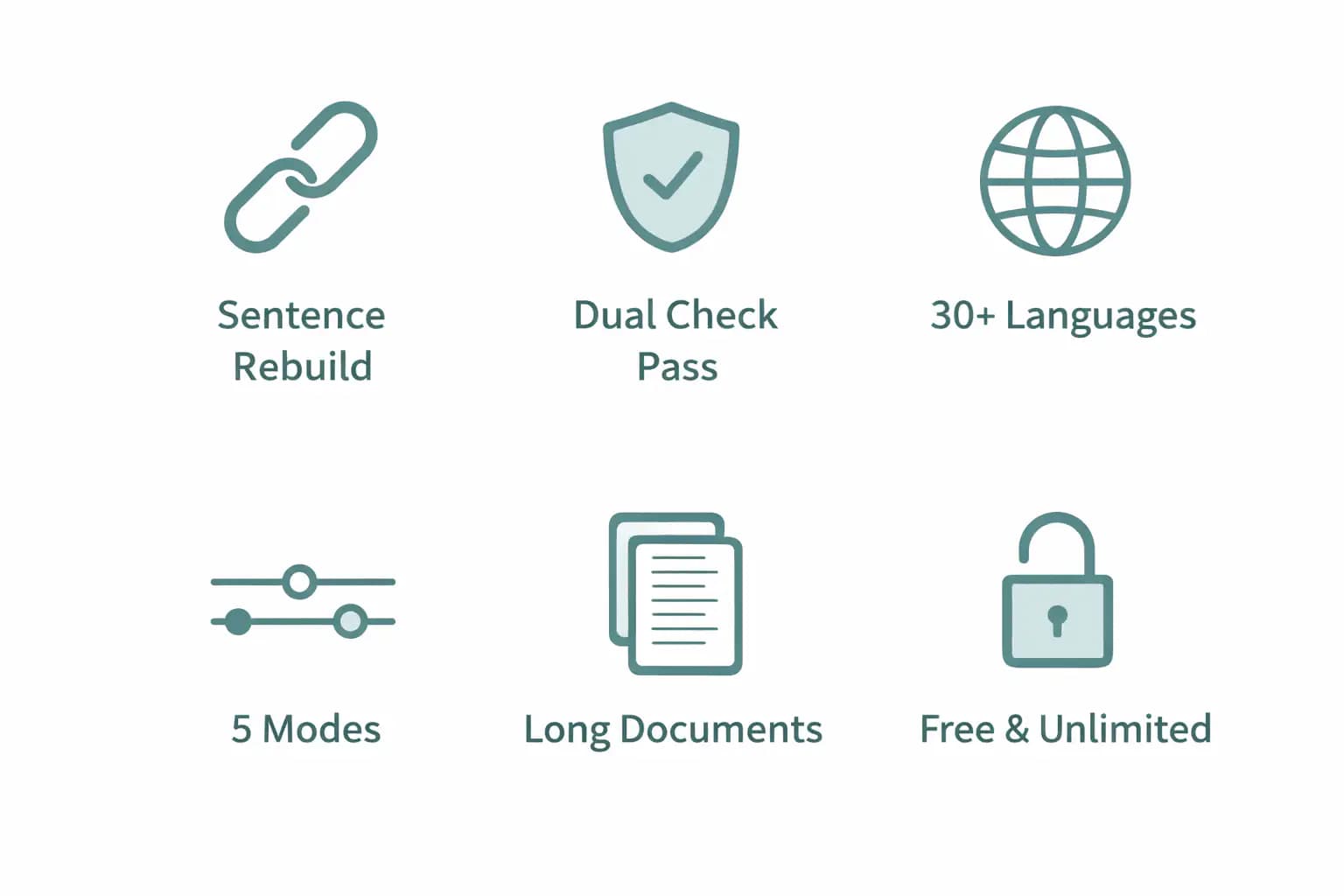

Handles long documents
Copyleaks performs better on longer texts — and so do we. Whether you're running 500 words or 5,000, output quality stays consistent throughout.
No signup. No word limits. Free.
No account needed. No cap on usage. Try it, check the result in Copyleaks, and if it passes — you're done.


What People Are Saying
"I've tried four different humanizers. This is the only one that consistently gets past Copyleaks. Everything else still shows 30–40% AI." — Graduate student, University of Manchester
"My clients run Copyleaks on every piece I deliver. Since I started using this, I haven't had a single flag. It's part of my workflow now." — Freelance content writer
"The Academic mode doesn't make my writing sound awkward — it just removes the AI feel without breaking the argument." — PhD candidate, social sciences


97% of users who test their output in Copyleaks score below 5% AI on the first pass.
Frequently Asked Questions
Does Copyleaks detect ChatGPT text?
Yes. Copyleaks detects content from ChatGPT, GPT-4, Claude, Gemini, and most other major LLMs. It doesn't train on specific models — it targets the underlying text generation patterns those models all share, which means it catches new AI tools as they appear too.
How accurate is Copyleaks AI detection?
Copyleaks claims over 99% accuracy with a 0.2% false positive rate. Real-world third-party tests put accuracy at 85–96% depending on content type, length, and how the text was processed. It performs best on texts over 500 words in formal or academic writing styles.
Can Copyleaks detect paraphrased AI text?
Yes — this is where it stands out. Standard paraphrasing tools like QuillBot typically leave AI scores of 38% or higher on Copyleaks scans. Our tool addresses the deeper structural patterns that paraphrasing doesn't fix.
Does Copyleaks check for plagiarism and AI at the same time?
Yes. That's one of its main advantages over dedicated AI-only detectors. A single scan runs both checks simultaneously — looking for copied content against billions of web pages and academic papers while also running the AI detection model. Our output is designed to pass both.
What is Copyleaks AI Logic?
AI Logic is a paid Copyleaks feature that explains why specific sentences were flagged. It highlights individual phrases and shows their AI-to-human frequency ratio — the evidence behind each flag. Our tool is built to fix exactly the kinds of patterns AI Logic would surface.
Does QuillBot bypass Copyleaks?
Not reliably. Testing consistently shows QuillBot-processed text still scores 38–50% AI on Copyleaks. Copyleaks looks at structural and statistical patterns that word-substitution tools don't address. Sentence-level reconstruction is what passes — not paraphrasing.
Is Copyleaks harder to bypass than GPTZero or ZeroGPT?
Generally, yes. GPTZero and ZeroGPT rely primarily on perplexity and burstiness scores. Copyleaks uses a wider multi-layer model that includes phrase frequency analysis, structural pattern matching, and cross-referencing with its plagiarism database. That combination is harder to fool with generic tools.
Does Copyleaks work in other languages?
Yes — it supports over 30 languages including French, Spanish, German, Portuguese, Italian, Japanese, Chinese, Russian, and Arabic. Our humanizer supports those languages too.
Can Copyleaks flag human-written text as AI?
It can, though the claimed false positive rate is below 0.2%. Real-world use sometimes produces false positives, particularly with very structured writing, non-native English, or short passages under 200 words. Our tool can also smooth out the over-structured patterns that trigger false positives on genuinely human writing.
Is it free to bypass Copyleaks with your tool?
Yes. No signup and no word limit. Paste your text, choose your mode, copy your output, and verify it in Copyleaks before submitting.
Try It Free — No Signup, No Limits
Paste your AI text, pick a mode, and get back content that scores 0% on Copyleaks. It takes about 15 seconds. Most people test it on one piece first — and end up using it for everything.